
World Rhythmic Gymnastics Championships viewing guide
An individual apparatus exercise and a group routine have different fields and results. Save the apparatus, group or individual designation and the relevant qualification or final session.
World Rhythmic Gymnastics Championships logo, 2025 Rhythmic Gymnastics World Championships. Original logo record.

Why five gold medals did not mean five apparatus
At Valencia in August 2023, Germany’s Darja Varfolomeev won five individual world titles. Four were apparatus titles, one each for hoop, ball, clubs and ribbon. The fifth was the individual all-around. The federation’s yearbook also records Italy’s Sofia Raffaeli as silver medallist in the all-around, hoop and ball. A ball medal ceremony and an all-around podium could therefore feature the same two gymnasts while belonging to different competitions.
To find one routine, begin with the apparatus you remember in the gymnast’s hands and choose the individual session. To follow the all-around outcome, keep the routines together and watch how the combined score develops. Group events appear in the same championships programme. The yearbook identifies China as the winner with five hoops and Israel as the winner with three ribbons and two balls. Those apparatus counts refer to equipment used by a group. They are a particularly handy clue when a short video has been filed under the broad label of rhythmic world finals.
International Gymnastics Federation · 2023 rhythmic gymnastics yearbookFrom the competition archive
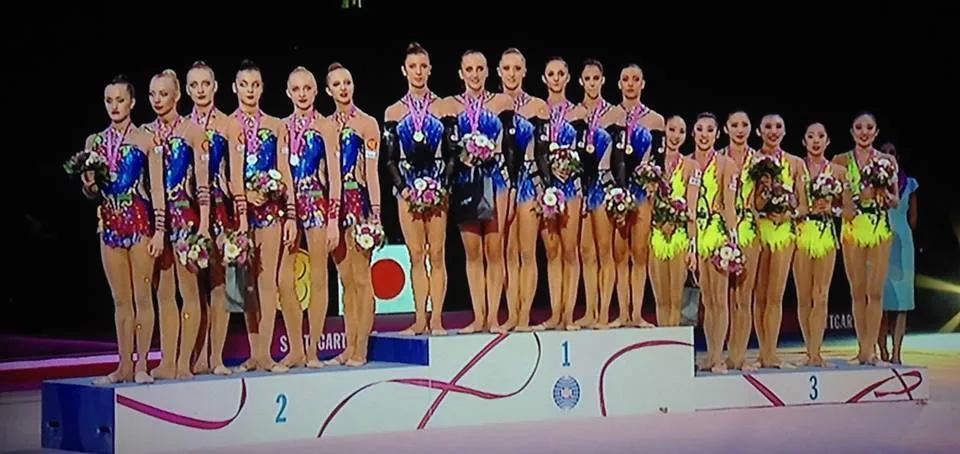

Which apparatus or group exercise?
An individual apparatus exercise and a group routine have different fields and results. Save the apparatus, group or individual designation and the relevant qualification or final session.
For World Rhythmic Gymnastics Championships, keep the discipline, apparatus, round and gymnast or group on the same line when saving a fixture. Gymnastics has several disciplines with distinct events. A competitor can appear in a team session, an individual final or a separate apparatus final. Confirm the discipline and round on the official start list before comparing scores.
Reading the programme and the archive
For an old World Rhythmic Gymnastics Championships broadcast, the opening graphic is often more informative than a modern upload title. Capture the season, participants and visible venue name. Use the competition background to place those details in context, then compare them with the results from the edition itself. A tribute, anniversary programme or compilation may deliberately mix action from several years.
World Rhythmic Gymnastics Championships schedules can attach more than one time to the same programme. Qualification can involve several groups or rotations, and an arena feed can move from one apparatus to another. Use the published subdivision and apparatus assignment. A single television start rarely indicates the moment a particular athlete begins.
What a host-city time means at home
Consider a clock example for a viewer following World Rhythmic Gymnastics Championships. Imagine that a programme lists 19:30 in Valencia on 12 December 2026. That reads 13:30 on 12 December in Toronto and 03:30 on 13 December in Tokyo. The example is a time conversion. A real fixture still needs its own published start and host city.
Using the same 19:30 in Valencia on 12 June 2027 gives 13:30 on 12 June in Toronto and 02:30 on 13 June in Tokyo. Compare those two dates before carrying a time difference into another World Rhythmic Gymnastics Championships round. If the scheduling app already displays your local time, save the entry as shown. Converting it again is how an otherwise correct reminder ends up an hour or a whole day out.
Who carries the event in your market?
Begin with the organizer’s event page for World Rhythmic Gymnastics Championships and choose the event, edition or fixture. Follow a “where to watch” link for the country in which the screen will be used. In the local broadcaster’s own guide, match the event details with the network or streaming service and the start of coverage. A worldwide organizer feed and a domestic broadcaster may use different names for the same programme.
Finding the part you came for
For an archive search under World Rhythmic Gymnastics Championships, start with the official results before typing a long description of a moment. A score for a routine and an overall final ranking answer different questions. Retain the apparatus and round with the athlete’s name. A highlights package may show a clean routine while omitting earlier attempts or other apparatus.
One documented edition
A dated example is 2023 Rhythmic Gymnastics World Championships. The published date or season is 23–27 August 2023. The edition profile identifies Feria Valencia in its venue or host information. Use those details when comparing a film of World Rhythmic Gymnastics Championships with an organizer’s newer season page. An upload date can be years after the competition, while the venue or edition on the original graphic ties the footage to its sporting record.
Venues in the record
The World Rhythmic Gymnastics Championships reference table pairs year, host city and country. Its entries include “1965 · Prague · Czechoslovakia”, “1967 · Copenhagen · Denmark” and “2023 · Valencia · Spain”. Ground and circuit names change with sponsors and renovations. A location in a contemporary report can survive a rebranding, which makes the city and venue useful when matching a later upload to an old programme.
| Year | Host city | Country |
|---|---|---|
| 1965 | Prague | Czechoslovakia |
| 1967 | Copenhagen | Denmark |
| 2023 | Valencia | Spain |
| 2025 | Rio de Janeiro | Brazil |
How the field is described
The World Rhythmic Gymnastics Championships reference table pairs nation, gold, silver and bronze. Its entries include “Russia · 113 · 57 · 35”, “Bulgaria · 71 · 68 · 57” and “France · 0 · 0 · 2”. A country, confederation or region can identify where an entrant qualified, the association it represented or where an event took place. Read the actual column headings before using a country as a clue to a viewing territory.
| Nation | Gold | Silver | Bronze |
|---|---|---|---|
| Russia | 113 | 57 | 35 |
| Bulgaria | 71 | 68 | 57 |
| France | 0 | 0 | 2 |
| South Korea | 0 | 0 | 1 |
Competition records and edition names
Two entries in the reference tables associated with World Rhythmic Gymnastics Championships illustrate the level of detail available. One records year 1965, country Czechoslovakia. The other records year 1967, country Denmark. Read these as entries from the competition’s background tables. A new fixture needs its own announcement. A source result, unlike a recycled highlights title, preserves the names or places used for that particular record.
Questions and answers
Which schedule details identify World Rhythmic Gymnastics Championships?
An individual apparatus exercise and a group routine have different fields and results. Save the apparatus, group or individual designation and the relevant qualification or final session.
World Rhythmic Gymnastics Championships organizerWorld Rhythmic Gymnastics Championships competition backgroundCivil time and clock changesDated edition profile for 2023 Rhythmic Gymnastics World ChampionshipsInternational Gymnastics Federation · 2023 rhythmic gymnastics yearbookOriginal logo record