
World Artistic Gymnastics Championships viewing guide
A gymnast can appear during qualification, the team final, all-around and apparatus finals. Name the apparatus and phase if you want a single routine instead of the whole session.
One gymnast, several score sheets in Antwerp
Simone Biles’s results from the 2023 Artistic Gymnastics World Championships in Antwerp offer a good way to distinguish the different finals in a television archive. The federation records 58.399 for her winning women’s all-around final and 58.865 for her qualifying all-around. Both are real scores from the same championships. A clip showing the higher figure belongs to qualification if it identifies that total, even though the gold medal was decided later with the lower one.
Individual apparatus results add another layer. Biles placed first on balance beam with 14.800 and first on floor exercise with 14.633. Her vault final score of 14.549 placed her second. A broadcast headed simply Biles wins in Antwerp might follow any one of those victories. Look for the apparatus named on the scoreboard, then check whether the display gives one routine’s mark or a running total across events. Those details are enough to catalogue a saved routine without confusing a vault medal with the all-around title.
International Gymnastics Federation · Simone Biles, Antwerp 2023 resultsFrom the competition archive
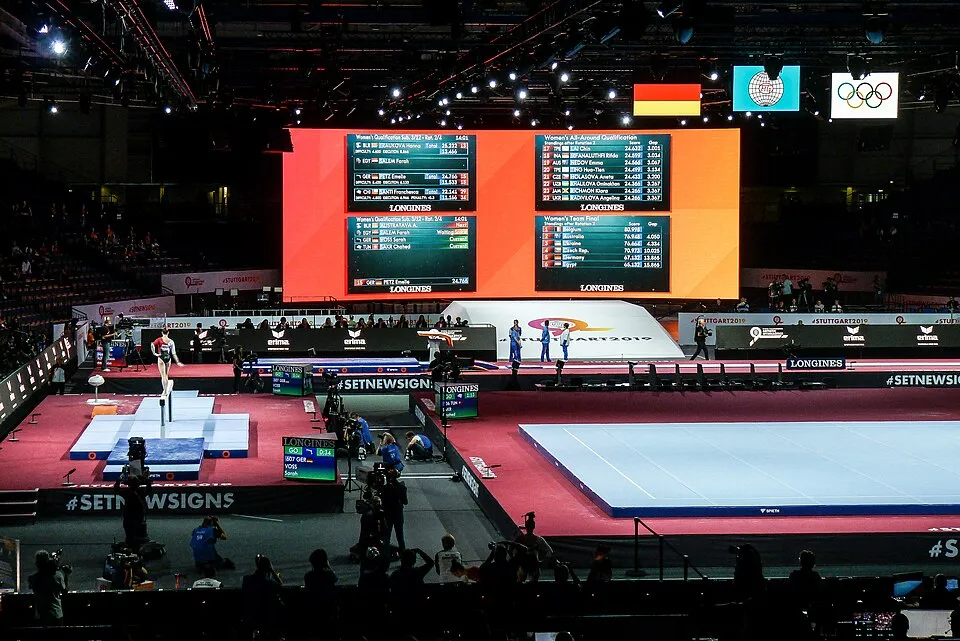

Team, all-around or apparatus?
A gymnast can appear during qualification, the team final, all-around and apparatus finals. Name the apparatus and phase if you want a single routine instead of the whole session.
For World Artistic Gymnastics Championships, keep the discipline, apparatus, round and gymnast or group on the same line when saving a fixture. Gymnastics has several disciplines with distinct events. A competitor can appear in a team session, an individual final or a separate apparatus final. Confirm the discipline and round on the official start list before comparing scores.
Reading the programme and the archive
For an old World Artistic Gymnastics Championships broadcast, the opening graphic is often more informative than a modern upload title. Capture the season, participants and visible venue name. Use the competition background to place those details in context, then compare them with the results from the edition itself. A tribute, anniversary programme or compilation may deliberately mix action from several years.
World Artistic Gymnastics Championships schedules can attach more than one time to the same programme. Qualification can involve several groups or rotations, and an arena feed can move from one apparatus to another. Use the published subdivision and apparatus assignment. A single television start rarely indicates the moment a particular athlete begins.
What a host-city time means at home
Consider a clock example for a viewer following World Artistic Gymnastics Championships. Imagine that a programme lists 19:30 in Antwerp on 12 December 2026. That reads 13:30 on 12 December in Toronto and 03:30 on 13 December in Tokyo. The example is a time conversion. A real fixture still needs its own published start and host city.
Using the same 19:30 in Antwerp on 12 June 2027 gives 13:30 on 12 June in Toronto and 02:30 on 13 June in Tokyo. Compare those two dates before carrying a time difference into another World Artistic Gymnastics Championships round. If the scheduling app already displays your local time, save the entry as shown. Converting it again is how an otherwise correct reminder ends up an hour or a whole day out.
Who carries the event in your market?
Begin with the organizer’s event page for World Artistic Gymnastics Championships and choose the event, edition or fixture. Follow a “where to watch” link for the country in which the screen will be used. In the local broadcaster’s own guide, match the event details with the network or streaming service and the start of coverage. A worldwide organizer feed and a domestic broadcaster may use different names for the same programme.
Finding the part you came for
For an archive search under World Artistic Gymnastics Championships, start with the official results before typing a long description of a moment. A score for a routine and an overall final ranking answer different questions. Retain the apparatus and round with the athlete’s name. A highlights package may show a clean routine while omitting earlier attempts or other apparatus.
One documented edition
A dated example is 2023 World Artistic Gymnastics Championships. The edition profile identifies Sportpaleis in its venue or host information. Use those details when comparing a film of World Artistic Gymnastics Championships with an organizer’s newer season page. An upload date can be years after the competition, while the venue or edition on the original graphic ties the footage to its sporting record.
Venues in the record
The World Artistic Gymnastics Championships reference table pairs year, edition, host city and country. Its entries include “1903 · 1 · Antwerp · Belgium”, “1905 · 2 · Bordeaux · France” and “2025 · 53 · Jakarta · Indonesia”. Ground and circuit names change with sponsors and renovations. A location in a contemporary report can survive a rebranding, which makes the city and venue useful when matching a later upload to an old programme.
| Year | Edition | Host city | Country |
|---|---|---|---|
| 1903 | 1 | Antwerp | Belgium |
| 1905 | 2 | Bordeaux | France |
| 2025 | 53 | Jakarta | Indonesia |
| 2026 | 54 | Rotterdam | Netherlands |
How the field is described
The World Artistic Gymnastics Championships reference table pairs nation, gold, silver and bronze. Its entries include “China · 73 · 39 · 32”, “Soviet Union · 61 · 46 · 31” and “Azerbaijan · 0 · 0 · 1”. A country, confederation or region can identify where an entrant qualified, the association it represented or where an event took place. Read the actual column headings before using a country as a clue to a viewing territory.
| Nation | Gold | Silver | Bronze |
|---|---|---|---|
| China | 73 | 39 | 32 |
| Soviet Union | 61 | 46 | 31 |
| Azerbaijan | 0 | 0 | 1 |
| Individual Neutral Athletes | 0 | 0 | 1 |
The Antwerp edition and the kind of final
The 2023 artistic worlds took place in Antwerp. For a routine from that edition, first establish whether the footage is from team competition, the individual all-around or an apparatus final. A commentary line describing a gymnast as world champion can refer to any of those results. Use the apparatus and the start list for that particular session before searching by the gymnast's name. A balance beam score from qualification and one from the apparatus final were earned on separate routines, even when the gymnast wore a similar leotard and used a familiar series of elements.
Competition records and edition names
Two entries in the reference tables associated with World Artistic Gymnastics Championships illustrate the level of detail available. One records year 1903, edition 1, country Belgium. The other records year 1905, edition 2, country France. Read these as entries from the competition’s background tables. A new fixture needs its own announcement. A source result, unlike a recycled highlights title, preserves the names or places used for that particular record.
Questions and answers
Which schedule details identify World Artistic Gymnastics Championships?
A gymnast can appear during qualification, the team final, all-around and apparatus finals. Name the apparatus and phase if you want a single routine instead of the whole session.