
Rugby League World Cup viewing guide
Rugby league has its own world tournament. Specify men's, women's or wheelchair competition and do not use rugby-union World Cup television schedules for a fixture carrying similar national flags.

2021 Rugby League World Cup competition logo. Original logo record.

Confirm the rugby code and division
Rugby league has its own world tournament. Specify men's, women's or wheelchair competition and do not use rugby-union World Cup television schedules for a fixture carrying similar national flags.
For Rugby League World Cup, keep the teams, ground, competition and round on the same line when saving a fixture. Rugby league and rugby union use different competitions and playing structures. Check the code first. A representative match and a club fixture can feature many of the same players without sharing team names, venue or rights arrangements.
From the competition archive

Reading the programme and the archive
For an old Rugby League World Cup broadcast, the opening graphic is often more informative than a modern upload title. Capture the season, participants and visible venue name. Use the competition background to place those details in context, then compare them with the results from the edition itself. A tribute, anniversary programme or compilation may deliberately mix action from several years.
Rugby League World Cup schedules can attach more than one time to the same programme. A schedule’s opening time can include studio build-up and team announcements. Use the ground and the published kickoff, particularly when comparing an Australian listing with a late-night or morning programme overseas.
What a host-city time means at home
Consider a clock example for a viewer following Rugby League World Cup. Imagine that a programme lists 19:30 in Sydney on 12 December 2026. That reads 08:30 on 12 December in London and 03:30 on 12 December in New York. The example is a time conversion. A real fixture still needs its own published start and host city.
Using the same 19:30 in Sydney on 12 June 2027 gives 10:30 on 12 June in London and 05:30 on 12 June in New York. Compare those two dates before carrying a time difference into another Rugby League World Cup round. If the scheduling app already displays your local time, save the entry as shown. Converting it again is how an otherwise correct reminder ends up an hour or a whole day out.
Who carries the event in your market?
Begin with the organizer’s event page for Rugby League World Cup and choose the event, edition or fixture. Follow a “where to watch” link for the country in which the screen will be used. In the local broadcaster’s own guide, match the event details with the network or streaming service and the start of coverage. A worldwide organizer feed and a domestic broadcaster may use different names for the same programme.
Finding the part you came for
For an archive search under Rugby League World Cup, start with the official results before typing a long description of a moment. To trace a try or an important tackle, keep the teams, half and clock. A condensed match can omit the earlier sets that created the field position. A match report and full replay provide different evidence of that sequence.
Earlier results
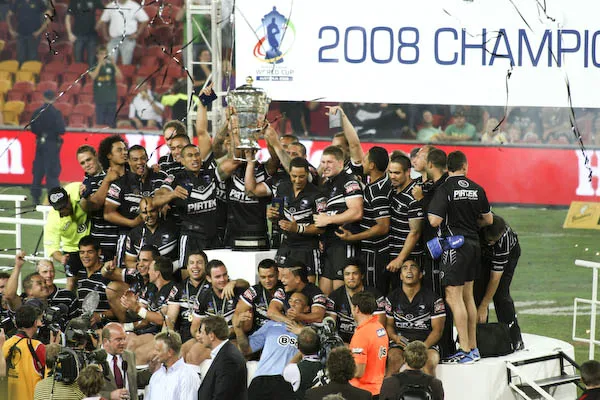
The Rugby League World Cup reference table pairs team, champions and runners-up. Its entries include “Great Britain · 3 (1954, 1960, 1972) · 4 (1957, 1970, 1977, 1992)” and “New Zealand · 1 (2008) · 4 (1985–88, 2000, 2013, 2026)”. A winner, a runner-up and a club’s cumulative title count answer different archive questions. For footage from one edition, begin with a specific dated result. A table covering several seasons can include the same name in several roles.
| Team | Champions | Runners-up |
|---|---|---|
| Great Britain | 3 (1954, 1960, 1972) | 4 (1957, 1970, 1977, 1992) |
| New Zealand | 1 (2008) | 4 (1985–88, 2000, 2013, 2026) |
Venues in the record
The Rugby League World Cup reference table pairs stadium, year and stage. Its entries include “Old Trafford · 2013 · Final”, “Wembley Stadium (1923) · 1989–92 · Final” and “Lang Park · 2026 · Final”. Ground and circuit names change with sponsors and renovations. A location in a contemporary report can survive a rebranding, which makes the city and venue useful when matching a later upload to an old programme.
| Stadium | Year | Stage |
|---|---|---|
| Old Trafford | 2013 | Final |
| Wembley Stadium (1923) | 1989–92 | Final |
| Lang Park | 2026 | Final |
| Lang Park | 2008 | Final |
Competition records and edition names
For an edition search, the competition profile for Rugby League World Cup records region (International (IRL)) and team field (10 (from 2026 finals)). Those are useful identifiers when an old television caption uses a different name or a translation. For a specific fixture, resolve the actual season first. Club membership, rules and venues in a general profile can reflect a later edition than the game in the archive.
Two entries in the reference tables associated with Rugby League World Cup illustrate the level of detail available. One records team Great Britain, champions 3 (1954, 1960, 1972). The other records team New Zealand, champions 1 (2008). Read these as entries from the competition’s background tables. A new fixture needs its own announcement. A source result, unlike a recycled highlights title, preserves the names or places used for that particular record.
Questions and answers
Which schedule details identify Rugby League World Cup?
Rugby league has its own world tournament. Specify men's, women's or wheelchair competition and do not use rugby-union World Cup television schedules for a fixture carrying similar national flags.