
EHF Champions League viewing guide
EHF identifies European handball. Add the men's or women's edition, teams and leg when looking up a continental tie. A local club may be in a domestic league that same week.

EHF Champions League logo, 2020 design in the source file. Original logo record. Credit: en:European Handball Federation. CC BY-SA 4.0.

Confirm the handball competition
EHF identifies European handball. Add the men's or women's edition, teams and leg when looking up a continental tie. A local club may be in a domestic league that same week.
For EHF Champions League, keep the national or club teams, arena and match stage on the same line when saving a fixture. Both clubs and national teams play major handball competitions. Look for the responsible federation and the event name. In a return leg an aggregate score and the result at the final whistle can tell different stories.
From the competition archive
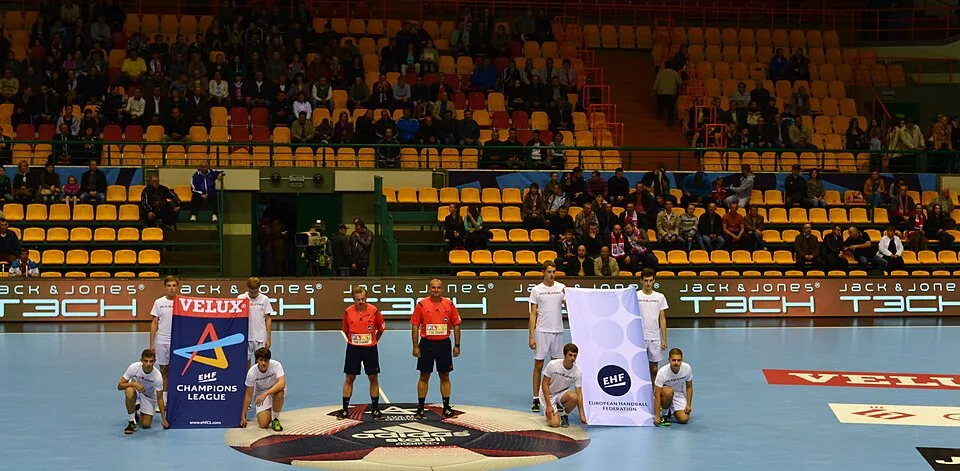

Reading the programme and the archive
The history of EHF Champions League reaches back to 1956. Among its identifying details are league level — 1. Take the edition year from the actual results when looking for archive footage. A present-day description can name a venue, format or governing body that was different when the footage was recorded. Compare the title on screen with the description in the competition background.
EHF Champions League schedules can attach more than one time to the same programme. An arena can host several matches during one tournament session. Use the exact fixture time, not just the start of the session. A host broadcaster may switch courts or join a second game after showing the first.
What a host-city time means at home
Consider a clock example for a viewer following EHF Champions League. Imagine that a programme lists 19:30 in Vienna on 12 December 2026. That reads 13:30 on 12 December in Toronto and 03:30 on 13 December in Tokyo. The example is a time conversion. A real fixture still needs its own published start and host city.
Using the same 19:30 in Vienna on 12 June 2027 gives 13:30 on 12 June in Toronto and 02:30 on 13 June in Tokyo. Compare those two dates before carrying a time difference into another EHF Champions League round. If the scheduling app already displays your local time, save the entry as shown. Converting it again is how an otherwise correct reminder ends up an hour or a whole day out.
Who carries the event in your market?
Begin with the organizer’s event page for EHF Champions League and choose the event, edition or fixture. Follow a “where to watch” link for the country in which the screen will be used. In the local broadcaster’s own guide, match the event details with the network or streaming service and the start of coverage. A worldwide organizer feed and a domestic broadcaster may use different names for the same programme.
Finding the part you came for
For an archive search under EHF Champions League, start with the official results before typing a long description of a moment. Use the half and game-clock time to find a goal or a defensive sequence. Keep the score with the timestamp. A short goals package can leave out an exclusion or timeout that explains the next possession.
One documented edition
A dated example is 2024–25 EHF Champions League. The published date or season is 11 September 2024 – 15 June 2025. The edition profile identifies Lanxess Arena (FINAL4) in its venue or host information. It records SC Magdeburg in the winning position and Füchse Berlin in second place. Its entry for teams reads 16. Use those details when comparing a film of EHF Champions League with an organizer’s newer season page. An upload date can be years after the competition, while the venue or edition on the original graphic ties the footage to its sporting record.
Earlier results
The EHF Champions League reference table pairs club, winners and runners-up. Its entries include “Barcelona · 13 · 5”, “VfL Gummersbach · 5 · 1” and “Paris Saint-Germain · 0 · 1”. A winner, a runner-up and a club’s cumulative title count answer different archive questions. For footage from one edition, begin with a specific dated result. A table covering several seasons can include the same name in several roles.
| Club | Winners | Runners-up |
|---|---|---|
| Barcelona | 13 | 5 |
| VfL Gummersbach | 5 | 1 |
| Paris Saint-Germain | 0 | 1 |
| HBC Nantes | 0 | 1 |
Reading the competition tables
The EHF Champions League reference table pairs player, goals and season. Its entries include “Jesús Martínez de la Cal · 17 · 2009/10”, “Mathias Gidsel · 17 · 2026/27” and “Mattéo Fadhuile · 14 · 2026/27”. Different reference tables can track editions, events, people or organizations. The headings preserve that distinction. Copying a name into a search without its category can make a season summary look like a result from one specific meeting.
| Player | Goals | Season |
|---|---|---|
| Jesús Martínez de la Cal | 17 | 2009/10 |
| Mathias Gidsel | 17 | 2026/27 |
| Mattéo Fadhuile | 14 | 2026/27 |
| Francisco Costa | 14 | 2026/27 |
Competition records and edition names
For an edition search, the competition profile for EHF Champions League records foundation (1956), country (EHF members), confederation (EHF (Europe)) and division level (1). Those are useful identifiers when an old television caption uses a different name or a translation. For a specific fixture, resolve the actual season first. Club membership, rules and venues in a general profile can reflect a later edition than the game in the archive.
Two entries in the reference tables associated with EHF Champions League illustrate the level of detail available. One records club Barcelona, winners 13. The other records club VfL Gummersbach, winners 5. Read these as entries from the competition’s background tables. A new fixture needs its own announcement. A source result, unlike a recycled highlights title, preserves the names or places used for that particular record.
Questions and answers
Which schedule details identify EHF Champions League?
EHF identifies European handball. Add the men's or women's edition, teams and leg when looking up a continental tie. A local club may be in a domestic league that same week.