
The stations listed under Hearst Communications Inc.
The broadcast directory credits Hearst Communications Inc. as owner on 16 station records. A&E, Lifetime, History show how that credit appears under different station names.
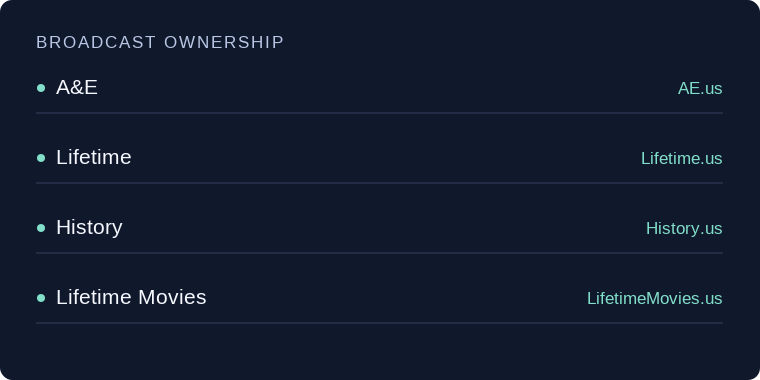
Where the names appear
The largest source-market group in this set is United States, with 16 of 16 records. There are 16 distinct display names. The most frequently recorded programme categories include documentary, entertainment, movies, lifestyle.
| Market | Station records |
|---|---|
| United States | 16 |
A dated cross-section
The earliest recorded launch in this set belongs to A&E on 1 February 1984. At the other end, VICE TV is dated 2 December 2019. These dates belong to the individual stations. They do not establish when ownership or affiliation began.
| Service | Source market | Launch recorded | Closure recorded | Network or category |
|---|---|---|---|---|
| A&E | United States | 1 February 1984 | — | entertainment |
| Lifetime | United States | 1 February 1984 | — | entertainment |
| History | United States | 1 January 1995 | — | A+E Networks |
| Lifetime Movies | United States | 29 June 1998 | — | movies |
| FYI | United States | 16 November 1998 | — | lifestyle |
| Lifetime Real Women | United States | 20 August 2001 | — | entertainment |
| History Africa | United States | 1 December 2003 | — | documentary |
| Crime + Investigation | United States | 1 April 2005 | — | entertainment |
| H2 | United States | 26 September 2011 | 29 February 2016 | documentary |
| History 2 Asia | United States | 14 June 2013 | 1 October 2022 | documentary |
| Viceland | United States | 29 February 2016 | 2 December 2019 | general |
| VICE TV | United States | 2 December 2019 | — | — |
What the stations carry
| Programme category | Named examples | In this set |
|---|---|---|
| Documentary | History, History Africa, H2 | 6 |
| Entertainment | A&E, Lifetime, Lifetime Real Women | 5 |
| General | Viceland | 1 |
| Lifestyle | FYI | 1 |
| Movies | Lifetime Movies | 1 |
Reading the historical entries
The source gives closing dates for 3 of these 16 records. The latest one recorded is History 2 Asia on 1 October 2022.
Source edition dated 1 November 2026. Historical station records identify names and relationships. They do not describe a TREX account’s current channel lineup.
From a recording to the station catalogue
Suppose a recording survives with only the programme title, a rough date and a few seconds of station identification. Transcribe the wording first. The record for A&E can be located using AE.us and, where relevant, AE.us. Write those lookup terms beside the transcription. Use them for research. The original on-screen lettering is still the evidence for what this particular recording displayed.
Next, place the sequence within the local programme day in United States. A title that aired after midnight may appear against the previous evening in a saved recording list. Try the adjoining date and keep the two programmes surrounding it. An advertisement or a short trailer is unlikely to identify the broadcaster by itself, while the following regional bulletin can provide a stronger clue.
Compare the result with Vice News only after locating a dated schedule or exact ident. Where the catalogue contains a former label, preserve it as an additional search term instead of editing the recording title. The next reader tracing Hearst Communications Inc. will then be able to follow the evidence in either direction without assuming that a familiar modern name appeared on the older recording.
Which network names accompany the owner credit?
Searching for Hearst Communications Inc. as an owner produces 16 station records. Counting printed station names instead gives 16. The most frequent filled network field is A+E Networks, attached to 3 rows. You can see that credit on entries for History, History en Espanol, and Military History. This difference in search fields matters when an old newspaper, programme credit or company announcement names a broadcaster differently from the guide on your screen.
United States contributes 16 of the 16 rows. Every record in the set points back to United States. Look at the actual station and its source market before treating a similar corporate label as the same business abroad. The database is a list of submitted relationships. It supplies no legal chain of control or date of purchase for Hearst Communications Inc..
What a listener or viewer can actually search
Military History carries the documentary classification in the station file. One point of comparison is A&E, filed under entertainment. A programme title can refer to a documentary strand, an individual film or a repeat. A one-word subject such as wildlife or history can match all three. If you are working from the Hearst Communications Inc. list, Military History is the example to look up. Read the episode or film subtitle, the running time where supplied, and the programme that follows it before matching a recording to the schedule.
Typing A&E into a guide can lead to more than one entry. This edition carries the identifier AE.us. The catalogue also uses the name for AE.au in Australia. A player’s search screen can shorten both to identical text. Open the programme details and compare the market field before adding either result to favourites. Keeping both identifiers beside a screenshot makes the mix-up much easier to explain.
Dates and location on the underlying records
The launch field for Military History is empty in the source edition. That is an unknown date, even when the website or logo looks familiar. Two dated points for comparison are History (1995) and History Africa (2003). A date from a neighbouring service cannot fill this gap. For an archive entry, cite the date on the actual recording or newspaper listing and leave the broadcaster’s launch year unassigned until a source ties it to MilitaryHistory.us.
Take a hypothetical listing for H2 at 20:30 UTC on 15 December 2026. In New York that becomes 15:30 on 15 December. Move the very same UTC start to 15 June 2027 and New York reads 16:30 on 15 June. Carrying a December offset into a June guide would change the result. Use the time in the city where you watch when setting a reminder. Neither example is a claim about a programme carried by H2.
What other records can establish about Hearst Communications Inc.
Consider what survives if you have an old schedule with a station name and a year but no logo. Across the records behind this Hearst Communications Inc. article, 12 of the 16 rows have a launch date, 3 have an alternate name, and 2 supply both. Lifetime Movies can be found under the date 29 June 1998 or via the alternate name LMN. Two points of agreement let you investigate an identity more closely. Missing data in one field is an invitation to consult the original schedule.
A separate relationship is available inside this selection. The successor field links H2 directly to Viceland. That is stronger evidence of a station change than two neighbouring launch dates. If a newspaper or recording supplies another spelling, retain the original words and their date beside your modern lookup. That keeps the contemporary evidence visible if a catalogue entry changes later.
The November edition records 14 station website fields in the records behind this Hearst Communications Inc. article. A site attached to a station can help find a primary programme listing. Its presence does not date a schedule change, and an owner group may use one address for several different channels. When quoting A&E, retain the precise programme page or printed listing you actually checked.
What a Hearst credit means for A&E
The Walt Disney Company’s fiscal 2024 annual report records that Disney and Hearst each owned half of A+E. This helps explain why an ownership search under Hearst and a separate search under A+E can both find the same programme brands. In a research note about Lifetime, retain the station name, the intermediary A+E credit and the date of the company filing. Adding both portfolio results together would count some underlying identities twice. A percentage in that annual report describes an interest in a business during the reported period.