
The stations listed under A+E Global Media
The broadcast directory credits A+E Global Media as owner on 11 station records. A&E, Lifetime, History show how that credit appears under different station names.
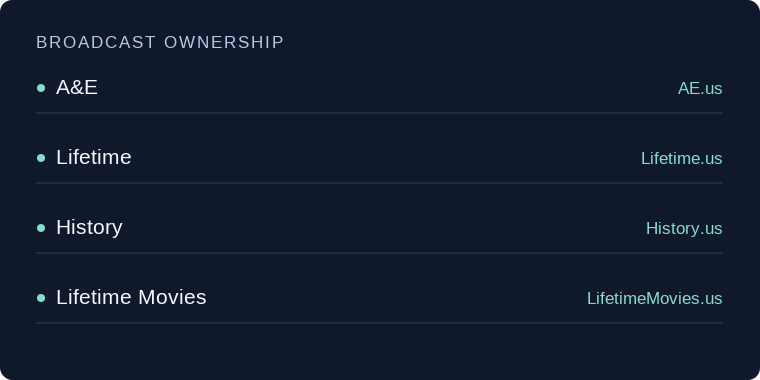
Where the names appear
The largest source-market group in this set is United States, with 11 of 11 records. There are 11 distinct display names. The most frequently recorded programme categories include entertainment, documentary, movies, lifestyle.
| Market | Station records |
|---|---|
| United States | 11 |
A dated cross-section
The earliest recorded launch in this set belongs to A&E on 1 February 1984. At the other end, VICE TV is dated 2 December 2019. These dates belong to the individual stations. They do not establish when ownership or affiliation began.
| Service | Source market | Launch recorded | Closure recorded | Network or category |
|---|---|---|---|---|
| A&E | United States | 1 February 1984 | — | entertainment |
| Lifetime | United States | 1 February 1984 | — | entertainment |
| History | United States | 1 January 1995 | — | A+E Networks |
| Lifetime Movies | United States | 29 June 1998 | — | movies |
| FYI | United States | 16 November 1998 | — | lifestyle |
| Lifetime Real Women | United States | 20 August 2001 | — | entertainment |
| Crime + Investigation | United States | 1 April 2005 | — | entertainment |
| H2 | United States | 26 September 2011 | 29 February 2016 | documentary |
| Viceland | United States | 29 February 2016 | 2 December 2019 | general |
| VICE TV | United States | 2 December 2019 | — | — |
What the stations carry
| Programme category | Named examples | In this set |
|---|---|---|
| Entertainment | A&E, Lifetime, Lifetime Real Women | 4 |
| Documentary | History, H2, Military History | 3 |
| General | Viceland | 1 |
| Lifestyle | FYI | 1 |
| Movies | Lifetime Movies | 1 |
Reading the historical entries
The source gives closing dates for 2 of these 11 records. The latest one recorded is Viceland on 2 December 2019. Its successor is listed as VICE TV.
Source edition dated 1 November 2026. Historical station records identify names and relationships. They do not describe a TREX account’s current channel lineup.
When the station is right but the programme looks wrong
Once you have found A&E, identify one programme you can recognize without using the station badge. A movie’s title and credited year, an episode subtitle, the name of a live bulletin or the teams in a match can all supply that second clue. The source category here is entertainment. It describes the service in broad terms and cannot identify a particular item on its schedule.
Open the detailed listing and note the programme immediately following it. If the picture is a repeat, the title may match a current search while the following programme belongs to a different television day. If you can replay a short piece, look for its opening card or a programme caption instead of guessing from one actor or presenter. Keep the original guide date visible in the comparison.
Use Military History only as a comparison on a clearly labelled second row. A test of A+E Global Media is meaningful if the person receiving the report can tell which service played, what its menu promised and what appeared on screen. A short note with those three observations does more than a photograph of two similar-looking station tiles.
Which network names accompany the owner credit?
Searching for A+E Global Media as an owner produces 11 station records. Counting printed station names instead gives 11. The most frequent filled network field is A+E Networks, attached to 2 rows. You can see that credit on entries for History and Military History. This difference in search fields matters when an old newspaper, programme credit or company announcement names a broadcaster differently from the guide on your screen.
United States contributes 11 of the 11 rows. Every record in the set points back to United States. Look at the actual station and its source market before treating a similar corporate label as the same business abroad. The database is a list of submitted relationships. It supplies no legal chain of control or date of purchase for A+E Global Media.
What a listener or viewer can actually search
Military History carries the documentary classification in the station file. One point of comparison is A&E, filed under entertainment. A programme title can refer to a documentary strand, an individual film or a repeat. A one-word subject such as wildlife or history can match all three. If you are working from the A+E Global Media list, Military History is the example to look up. Read the episode or film subtitle, the running time where supplied, and the programme that follows it before matching a recording to the schedule.
Typing A&E into a guide can lead to more than one entry. This edition carries the identifier AE.us. The catalogue also uses the name for AE.au in Australia. A player’s search screen can shorten both to identical text. Open the programme details and compare the market field before adding either result to favourites. Keeping both identifiers beside a screenshot makes the mix-up much easier to explain.
Dates and location on the underlying records
The launch field for Military History is empty in the source edition. That is an unknown date, even when the website or logo looks familiar. Two dated points for comparison are History (1995) and History Africa (2003). A date from a neighbouring service cannot fill this gap. For an archive entry, cite the date on the actual recording or newspaper listing and leave the broadcaster’s launch year unassigned until a source ties it to MilitaryHistory.us.
Take a hypothetical listing for Lifetime Real Women at 20:30 UTC on 15 December 2026. In New York that becomes 15:30 on 15 December. Move the very same UTC start to 15 June 2027 and New York reads 16:30 on 15 June. Carrying a December offset into a June guide would change the result. Use the time in the city where you watch when setting a reminder. Neither example is a claim about a programme carried by Lifetime Real Women.
What other records can establish about A+E Global Media
Consider what survives if you have an old schedule with a station name and a year but no logo. Across the records behind this A+E Global Media article, 10 of the 11 rows have a launch date, 2 have an alternate name, and 2 supply both. Lifetime Movies can be found under the date 29 June 1998 or via the alternate name LMN. Two points of agreement let you investigate an identity more closely. Missing data in one field is an invitation to consult the original schedule.
A separate relationship is available inside this selection. The successor field links H2 directly to Viceland. That is stronger evidence of a station change than two neighbouring launch dates. If a newspaper or recording supplies another spelling, retain the original words and their date beside your modern lookup. That keeps the contemporary evidence visible if a catalogue entry changes later.
The November edition records 9 station website fields in the records behind this A+E Global Media article. A site attached to a station can help find a primary programme listing. Its presence does not date a schedule change, and an owner group may use one address for several different channels. When quoting A&E, retain the precise programme page or printed listing you actually checked.
Following a programme brand through the company accounts
A&E, HISTORY and Lifetime appear together in Disney’s fiscal 2024 annual report, which also identifies Hearst as an equal partner in A+E. The punctuation matters in a search. A&E can refer to the named channel, while A+E identifies the wider business in those accounts. Someone looking for a History programme needs the channel, edition and local schedule. Someone checking how the business was owned in 2024 needs the corporate filing and its reporting period. The two searches begin with familiar brand names and finish with different pieces of evidence.