
The edges of the player guide are cut off on the TV
Use the player’s own menu to judge the edges. If the clock, buttons or outer rows of the guide disappear as well as part of the programme picture, check the display’s scaling.
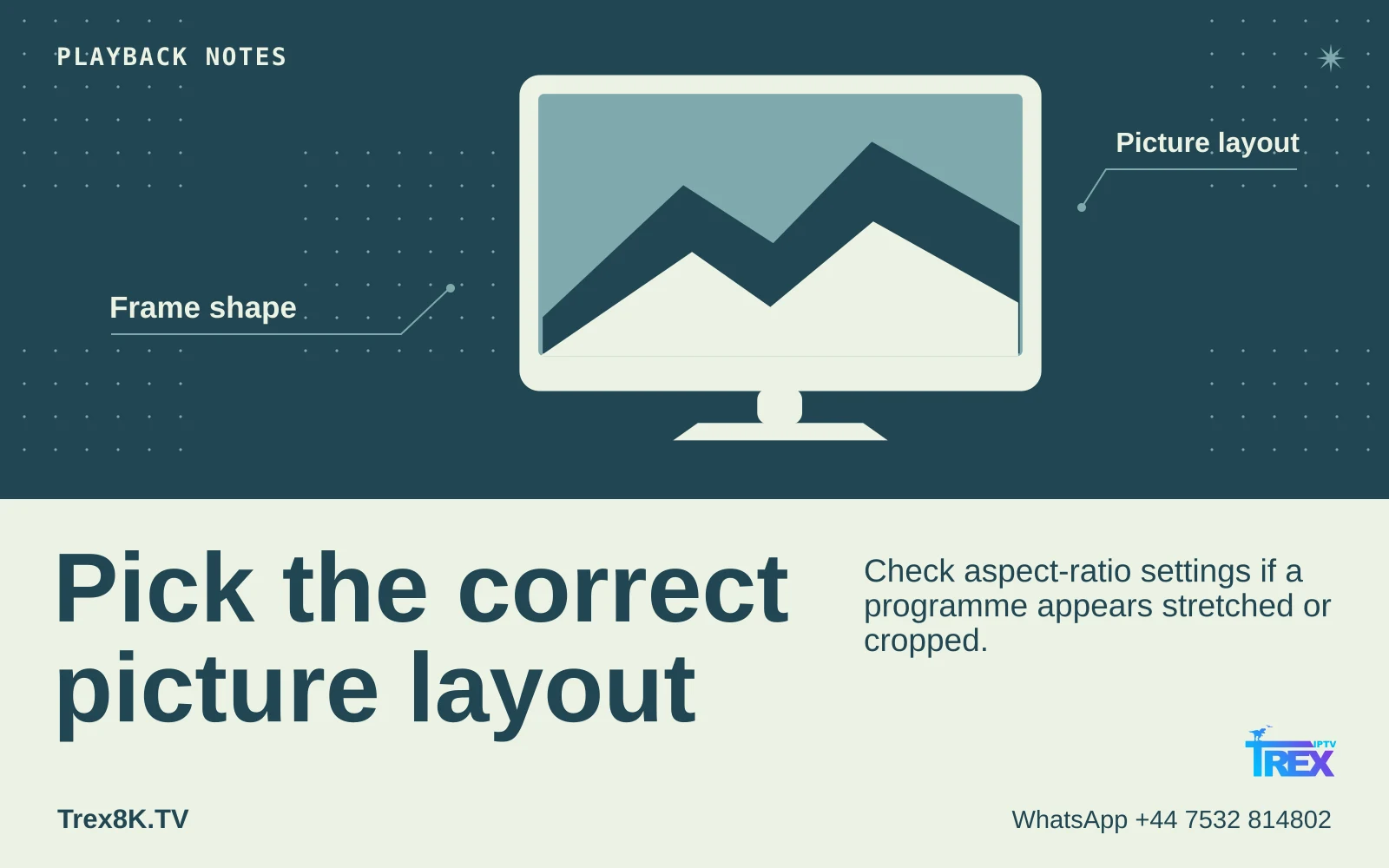
Find the display’s original-size option
Manufacturers use different names for picture size, fit and overscan. Record the current setting on this input. Choose the television’s option for showing the full input without zoom, if available, and return to the original guide. Use the menu lettering and clock to see whether the missing edges have reappeared.
Keep the fix attached to the right input
A television can retain different picture settings for different HDMI inputs or sources. If the built-in TV menus fit while a single box’s whole interface is clipped, report which input the box uses and which screens are affected. Include a description of the missing controls rather than a photograph that reveals account information.
Use lettering near the edges as a reference
Find a screen with a visible border or text near all four edges. The programme guide is useful if its first time column or final channel name is cut in half. Compare the picture from the player with the television’s own settings menu. If the TV menu fits and the HDMI picture is clipped, keep the input name and external device model beside the observation.
Check another screen from the same external device. If the external device’s Home screen loses the same edge, that points away from a single programme. If every app fits except one player menu, look for the player’s display or zoom setting before changing the television’s global picture size. A film’s intentional black bars can remain even when every menu edge fits correctly.
Find a setting you can reverse
Photograph or write down the current aspect, fit or zoom setting. Use the television’s documentation for your particular model to locate the control. Some settings apply separately to different inputs. If you temporarily change the fitting mode, look at the same guide row and the opposite edge before deciding whether to keep it. A fix for the left-hand time column should not cut the bottom button labels.
If the television is connected to Apple TV, Apple’s overscan guidance describes the distinction between enlarging an image and retaining its edges. For support, send the TV model, input, external device if used and a description of which edges were cropped. A photograph showing part of the physical bezel makes the scale easier to judge. Cover programme account names and other private details before sharing it.
After someone changes the picture size
Check a menu that uses all four corners, then play a programme in its normal shape. A sports score at the top, subtitles near the bottom and a channel number at the side each test a different edge. If you reset a single HDMI input to its former size, confirm the television’s own apps still look as you expect. Keep a note of the setting that worked for the device and the input to which it was connected. That way a future change of HDMI port can be diagnosed without anyone trying another subscription or re-entering working player credentials.
Questions and answers
How do I tell a cropped TV interface from normal black bars?
A cropped interface loses menu labels, buttons or edges on the affected input. Black bars around a film can preserve its intended shape while the complete player interface still fits.