Australian Open competition guide
The Australian Open match schedule distinguishes courts and day or night sessions. A date alone can identify several different broadcasts from Melbourne.

Match the arena and session to your listing
Start with Rod Laver Arena, Margaret Court Arena or the named outside court, then look for the player and session. Ticketing details may also give an arena door-opening time. A door time tells spectators when they can enter and is a poor substitute for the match listing.
A night match in Melbourne can fall much earlier in the day overseas. Convert the dated session time once and keep the Melbourne date with it when searching for a replay.
Reference details
| Field | Entry |
|---|---|
| Directory name | Australian Open |
| Entry type | Sports competition or body |
| Sport | Tennis |
Find this competition
Background to the name
| Detail | Reference record |
|---|---|
| Founded | 1905 |
| Location | Melbourne CBD |
| Venue | Melbourne Park (since 1988) |
Which Melbourne Park session is this?
A day ticket, a night session and a named court each identify different things at the Australian Open. Rod Laver Arena and Margaret Court Arena can carry matches at the same time. A viewer following one player should work from that court's published order of play.
For Australian Open, keep the tournament, court, draw and player pairing on the same line when saving a fixture. The order of play puts a pairing on a court in a particular sequence. “Followed by” is different from a fixed start. Singles, doubles and qualifying can share the same ground, and a player may appear more than once in a day with a different partner or opponent.
Reading the programme and the archive
The history of Australian Open reaches back to 1905. Among its identifying details are venue — Melbourne Park (since 1988), surface — Hard – outdoors (since 1988) Grass – outdoors (1905–1987). Take the edition year from the actual results when looking for archive footage. A present-day description can name a venue, format or governing body that was different when the footage was recorded. Compare the title on screen with the description in the competition background.
Australian Open schedules can attach more than one time to the same programme. A court can run late after a long preceding match. Save the day and court alongside the players, then return to the live order of play near the session. A rain interruption or court change can make an old start-time graphic a poor guide to what is on now.
What a host-city time means at home
Consider a clock example for a viewer following Australian Open. Imagine that a programme lists 19:30 in Melbourne on 12 December 2026. That reads 08:30 on 12 December in London and 03:30 on 12 December in New York. The example is a time conversion. A real fixture still needs its own published start and host city.
Using the same 19:30 in Melbourne on 12 June 2027 gives 10:30 on 12 June in London and 05:30 on 12 June in New York. Compare those two dates before carrying a time difference into another Australian Open round. If the scheduling app already displays your local time, save the entry as shown. Converting it again is how an otherwise correct reminder ends up an hour or a whole day out.
Who carries the event in your market?
Begin with the organizer’s event page for Australian Open and choose the event, edition or fixture. Follow a “where to watch” link for the country in which the screen will be used. In the local broadcaster’s own guide, match the event details with the network or streaming service and the start of coverage. A worldwide organizer feed and a domestic broadcaster may use different names for the same programme.
Finding the part you came for
For an archive search under Australian Open, start with the official results before typing a long description of a moment. Look for a full-match replay when you want the changing pattern across a set. A tournament highlights show can move from court to court and a short individual clip can contain only a deciding point. The round and opponent help identify a particular meeting.
Competition picture desk
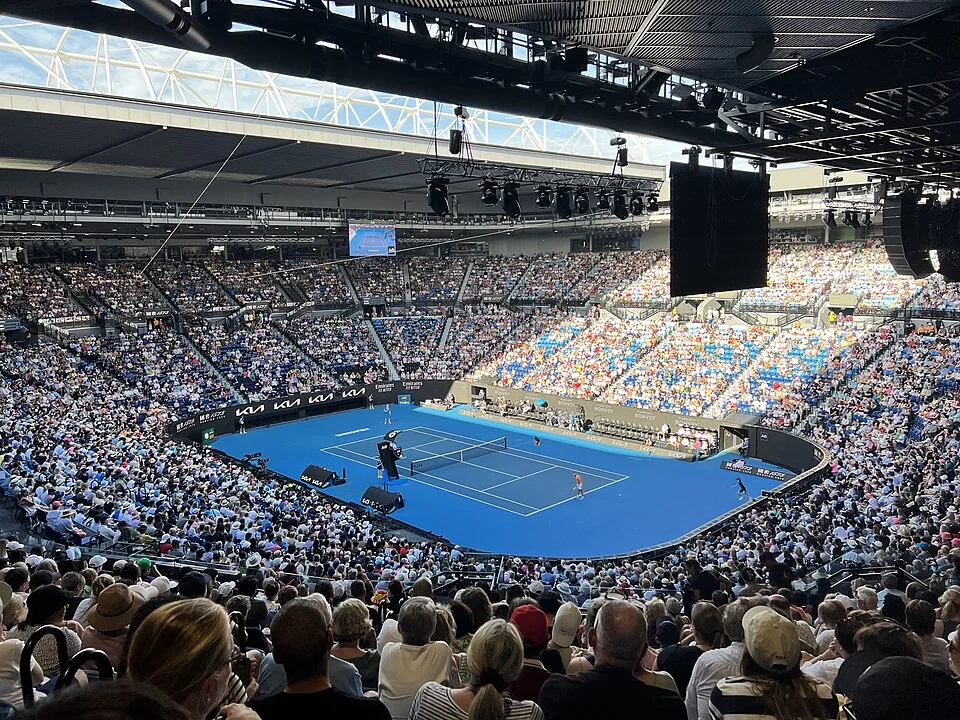

One documented edition
A dated example is 2024 Australian Open. The published date or season is 14–28 January 2024. The edition profile identifies Melbourne Park in its venue or host information. Its entry for draw reads 128S / 64D. Use those details when comparing a film of Australian Open with an organizer’s newer season page. An upload date can be years after the competition, while the venue or edition on the original graphic ties the footage to its sporting record.
Earlier results
The Australian Open reference table pairs champion, runner-up and score. Its entries include “Carlos Alcaraz · Novak Djokovic · 2–6, 6–2, 6–3, 7–5”, “Elena Rybakina · Aryna Sabalenka · 6–4, 4–6, 6–4” and “Elise Mertens Zhang Shuai · Anna Danilina Aleksandra Krunić · 7–6 (7–4), 6–4”. A winner, a runner-up and a club’s cumulative title count answer different archive questions. For footage from one edition, begin with a specific dated result. A table covering several seasons can include the same name in several roles.
| Champion | Runner-up | Score |
|---|---|---|
| Carlos Alcaraz | Novak Djokovic | 2–6, 6–2, 6–3, 7–5 |
| Elena Rybakina | Aryna Sabalenka | 6–4, 4–6, 6–4 |
| Elise Mertens Zhang Shuai | Anna Danilina Aleksandra Krunić | 7–6 (7–4), 6–4 |
| Olivia Gadecki John Peers | Kristina Mladenovic Manuel Guinard | 4–6, 6–3, |
Reading the competition tables
The Australian Open reference table pairs record and years. Its entries include “Most singles titles · 2008, 2011–2013, 2015–2016, 2019–2021, 2023”, “Most consecutive singles titles · 2011–2013, 2019–2021” and “Most doubles titles · 2007–2011, 2013–2015”. Different reference tables can track editions, events, people or organizations. The headings preserve that distinction. Copying a name into a search without its category can make a season summary look like a result from one specific meeting.
| Record | Years |
|---|---|
| Most singles titles | 2008, 2011–2013, 2015–2016, 2019–2021, 2023 |
| Most consecutive singles titles | 2011–2013, 2019–2021 |
| Most doubles titles | 2007–2011, 2013–2015 |
| Most consecutive doubles titles | 2007–2011 |
Questions and answers
Which schedule details identify Australian Open?
A day ticket, a night session and a named court each identify different things at the Australian Open. Rod Laver Arena and Margaret Court Arena can carry matches at the same time. A viewer following one player should work from that court's published order of play.
Illustrated guides