Dune: Prophecy · series guide
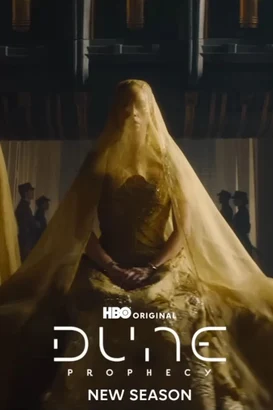
The Bene Gesserit’s origins belong to this television story in the Dune universe. Denis Villeneuve’s feature series follows a different route through the material. An episode of Prophecy should have a season identifier. For someone coming from Dune: Part Three, that format clue is worth more than similar desert artwork.
Reading Dune: Prophecy
Dune film audiences arrive with some idea of what the Bene Gesserit will become. The series can ask a different question about the decisions that gave an institution that form. A scene between two sisters therefore deserves as much attention as a formal pronouncement. The history of a powerful organisation might begin as an argument between people who know each other well.
Who made Dune: Prophecy?
The series creator credit for Dune: Prophecy names Diane Ademu-John and Alison Schapker. The showrunner credit includes Alison Schapker. A series gives several directors, writers and performers room to shape individual instalments over time. The role attached to a name matters when you are looking for a particular contribution. For a decision about the programme’s premise start with the series credits. For an episode’s staging or script, use the names in that episode’s end titles. An interview with Diane Ademu-John and Alison Schapker about the programme can concern a different stage of its development.
Two names from the cast of Dune: Prophecy help put faces to the programme. Emily Watson is credited as Mother Superior Valya Harkonnen, while Olivia Williams appears as Reverend Mother Tula Harkonnen. These are series-level credits. In a returning programme the order of the cast on the opening card can change, and a character seen in an earlier run may be absent from a particular instalment. For a guest performance, match the episode title first and then read that episode’s own credits.
From the credits to the screen
The craft credits for Dune: Prophecy include Pierre Gill for cinematography and Volker Bertelmann for music. On a first viewing those contributions are often experienced as one thing. A stretch of music can make a pause feel prolonged, or a change of image can leave the ear following something that has moved out of sight. On a second pass, choose a short scene and notice what your attention follows first. The screen credits identify the teams behind those distinct experiences.
Production credits for Dune: Prophecy include Wandering Jew Productions and Herbert Properties, Inc.. The series record names HBO in its broadcast history. The language record lists English. A broadcaster listing can help locate the correct programme when the title is translated. For Dune: Prophecy, keep the original programme record and the particular episode together before looking for a local edition. A service operating in another country can have a different schedule, different captions or a different selection of seasons. Check the title page presented to the account where you intend to watch.
Which edition is dated here?
Dune: Prophecy has a recorded series start of 17 November 2024. The supplied artwork is filed with season 2. The series reference gives 58–80 minutes for an episode. That figure is a guide to the scale of an instalment, and a particular chapter can have its own running time. When a player opens on the most recent season by default, check the season and episode title before pressing play. Someone starting at the beginning needs the original sequence, even if a new poster has replaced the one used for the premiere.
Other work to explore through the credits
Volker Bertelmann appears in the music credits for both Dune: Prophecy and Verity. Our other entry identifies Verity as a feature. That is a reason to put the two records beside each other without forcing them into story order. A viewer interested in the artist can compare one sequence from each work, then return to the end titles to see which other collaborators changed between the two.
Clayface offers a second point of comparison. Volker Bertelmann has music credits on both works. To follow the connection, take the name into the second guide and find the role attached to this particular production. An actor’s characters, a writer’s stories or a musician’s scores can inhabit entirely separate worlds. The repeated name is the documented link between these two entries.
Credits at a glance
| Credit | Reference entry |
|---|---|
| Direction | Anna Foerster and Richard J. Lewis |
| Series creators | Diane Ademu-John and Alison Schapker |
| Television development | Diane Ademu-John and Alison Schapker |
| Selected cast | Emily Watson, Olivia Williams, Travis Fimmel, Jodhi May, and Sarah-Sofie Boussnina |
| Cinematography | Pierre Gill |
| Music | Volker Bertelmann |
| Classifications | Drama and Science fiction |
| Production companies | Wandering Jew Productions, Herbert Properties, Inc., Flying Life, and Legendary Television |
| Broadcaster or original network | HBO |
| Language in the production record | English |
| Production country or countries | United States |
| Reference running time | 58–80 minutes |
Identify this work
| Field | Record |
|---|---|
| Title | Dune: Prophecy |
| Format | Television series |
| Catalogue identifier | series:90228 |
| Date recorded by title catalogue | 17 November 2024 |
| Season specified | 2 |
Nearby dates in the series index
| Title | Recorded date | Compared with Dune: Prophecy |
|---|---|---|
| Nobody Wants This | 26 September 2024 | 52 days earlier |
| North of North | 7 January 2025 | 51 days later |
Questions and answers
Who is credited as Mother Superior Valya Harkonnen in Dune: Prophecy?
Emily Watson is credited as Mother Superior Valya Harkonnen in this series. The cast also includes Olivia Williams as Reverend Mother Tula Harkonnen.
Illustrated guides