Project Hail Mary · film guide
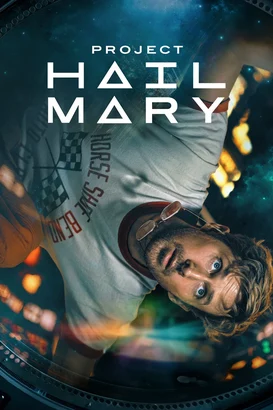
Ryan Gosling plays a science teacher who wakes up far from Earth in this screen adaptation of Andy Weir’s 2021 novel.
Reading Project Hail Mary
Ryland Grace comes from Andy Weir's novel before he appears on screen. Ryan Gosling plays him in the film by Phil Lord and Christopher Miller. If you arrived through an audiobook recommendation, look for the feature and its directors. The same story exists in a spoken performance that can appear in a general media search.
There is a pleasure in following a scientist who lacks the most basic fact about his own situation. Each observation has two jobs. It can narrow a practical problem in the spacecraft and recover a piece of the life that brought Grace there. A plot summary supplies the answers much faster than the character is able to earn them.
Who made Project Hail Mary?
Project Hail Mary appears twice in the source history. Andy Weir is credited for the material that carries that name, and Phil Lord and Christopher Miller for directing the feature. The film’s writing credits include Drew Goddard. In a catalogue that also holds printed work, games or other adaptations, try the screen credit beside Project Hail Mary. The combination points to the work in which the story is presented through a performance, a camera or an animator’s choices. It is especially helpful when a poster keeps the source title but drops the author’s name.
Ryan Gosling plays Ryland Grace in Project Hail Mary. Alongside that credit, Sandra Hüller is listed as Eva Stratt. Those two pairings can settle an identification when a poster gives the names of actors but a synopsis speaks only about characters. They are also a quiet way to prepare for a first screening. You can recognise two people when their names come up in dialogue without reading a plot breakdown that explains what either of them will do next.
From the credits to the screen
Two hands shape the way a scene in Project Hail Mary reaches the screen. The credits name Greig Fraser for cinematography and Joel Negron for editing. The music credits include Daniel Pemberton. Try watching an exchange once for the arrangement within a shot, then again for the moment the image changes. A reaction shot held for another beat can shift an audience’s sympathy without altering a line of dialogue. The camera and editing credits give you precise names for the two parts of that observation.
Production credits for Project Hail Mary include Amazon MGM Studios and Lord Miller Productions. Amazon MGM Studios (United States and Canada) appears in the distribution credits. The language record lists English. Those details explain the path from a picture being made to it being shown, and they can take different forms in different countries. To choose a dubbed or subtitled showing of Project Hail Mary, read the actual ticket or player language menu. A distributor’s name on a poster supplies no information about which audio or caption tracks a particular local edition carries.
Which edition is dated here?
The reference record dates Project Hail Mary to 19 March 2026 and gives a running time of 156 minutes. The running time is useful when distinguishing the feature from a trailer, a preview or an interview filed under its name. A scheduled television slot can run longer because it includes introductions, breaks or a following programme. If timing matters, compare the edition named by the venue or player with the film credit before treating the length of the schedule block as the length of the picture.
Other work to explore through the credits
Joel Negron appears in the editing credits for both Project Hail Mary and The Thomas Crown Affair. Our other entry identifies The Thomas Crown Affair as a feature. That is a reason to put the two records beside each other without forcing them into story order. A viewer interested in the artist can compare one sequence from each work, then return to the end titles to see which other collaborators changed between the two.
The Drama offers a second point of comparison. Daniel Pemberton has music credits on both works. To follow the connection, take the name into the second guide and find the role attached to this particular production. An actor’s characters, a writer’s stories or a musician’s scores can inhabit entirely separate worlds. The repeated name is the documented link between these two entries.
Credits at a glance
| Credit | Reference entry |
|---|---|
| Direction | Phil Lord and Christopher Miller |
| Writing | Drew Goddard |
| Selected cast | Ryan Gosling, Sandra Hüller, James Ortiz, and Lionel Boyce |
| Cinematography | Greig Fraser |
| Editing | Joel Negron |
| Music | Daniel Pemberton |
| Classifications | science fiction film, adventure film, action film, and Hopecore |
| Production companies | Amazon MGM Studios, Lord Miller Productions, Pascal Pictures, Open Invite Entertainment, and Waypoint Entertainment |
| Language in the production record | English |
| Production country or countries | United States |
| Source material and credit | Project Hail Mary · Andy Weir |
| Reference running time | 156 minutes |
Why a science teacher is in space
The mystery begins with the sun itself. Gosling’s character has to work out what is making it fade from a spacecraft millions of miles away. Amazon MGM’s guide ties the feature to Weir’s book, a helpful distinction when a search also turns up the audiobook or another recording with the same name.
Identify this work
| Field | Record |
|---|---|
| Title | Project Hail Mary |
| Format | Film |
| Catalogue identifier | movie:687163 |
| Date recorded by title catalogue | 19 March 2026 |
Nearby dates in the film index
| Title | Recorded date | Compared with Project Hail Mary |
|---|---|---|
| The Bride! | 6 March 2026 | 13 days earlier |
| Ready or Not: Here I Come | 20 March 2026 | 1 day later |
Questions and answers
What source material does Project Hail Mary credit?
The feature credits name Project Hail Mary and cite Andy Weir in the source history. The director, screenwriters and performers have separate credits for the screen production.
Illustrated guides