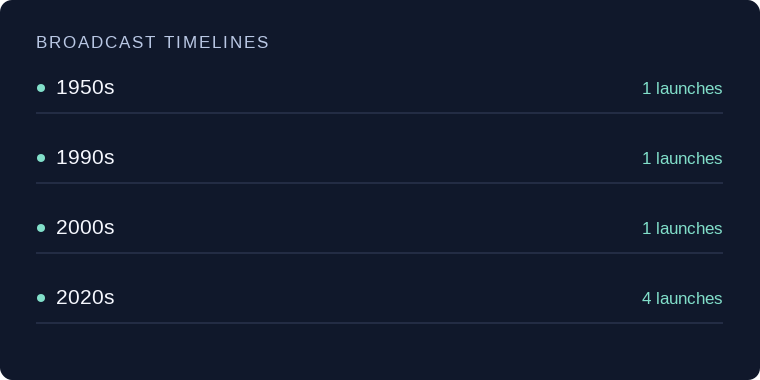
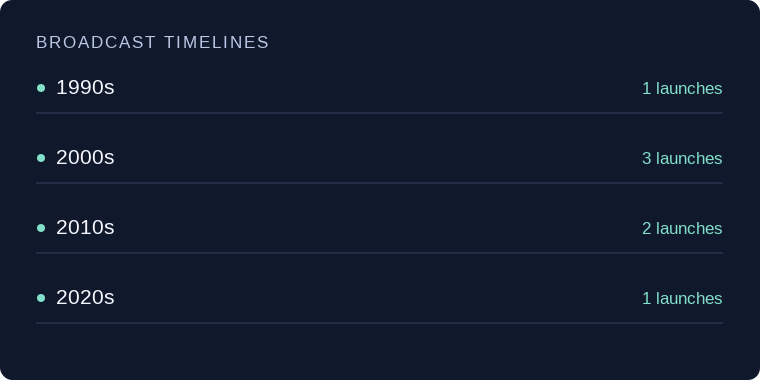
The chronology opens with 2GB, dated 23 August 1926. At the other end is News24 World on 27 July 2026. Reading between the two is a way to place an older service in its broadcast period, particularly when a present-day channel list starts with alphabetical order and hides launch dates.
Of the 9 dated entries in this group, 4 fall in the 2020s. That count follows the specific category and source market named in the article. For a reference to 2GB or News24 World, start with its own row. A concentration of launches in one decade cannot establish the date of a particular programme.
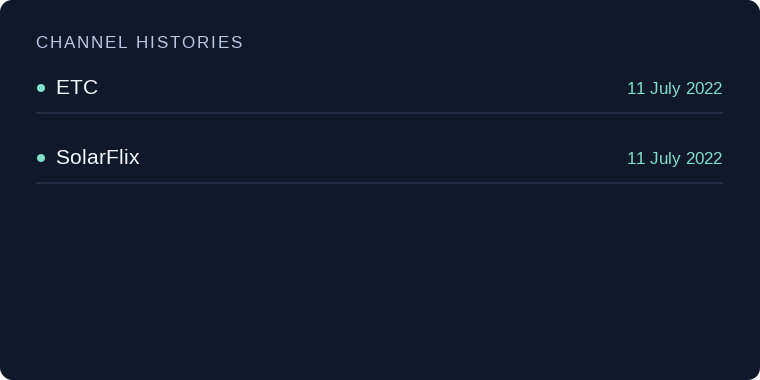
An old guide may still contain ETC. Following its reference to the next station yields SolarFlix in Philippines. The names belong to separate catalogue identifiers, ETC.ph and SolarFlix.ph. Preserve both if you are matching a recording made close to the handover.
The former entry records 11 July 2022 as its closing date. The next entry gives 11 July 2022 as its launch. Those two dates answer a narrower question than “when did the picture change on my TV?” They identify the change documented for ETC and give you two names to try in a historical listing.
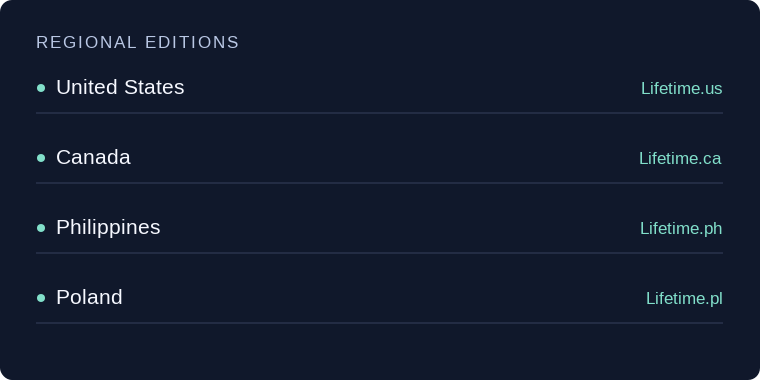
Two records illustrate the naming problem in the Lifetime guide. One is Lifetime.us, filed under United States. Another is Lifetime.ca, filed under Canada. A search result can show the same display name for both. The two country fields are the quickest way to separate these particular entries.
The comparison for Lifetime brings together 4 entries across 4 source markets. When an app hides the market in a short results list, open the station information. A programme title alongside the identifier will be easier to match with an old schedule than the first result on the remote.
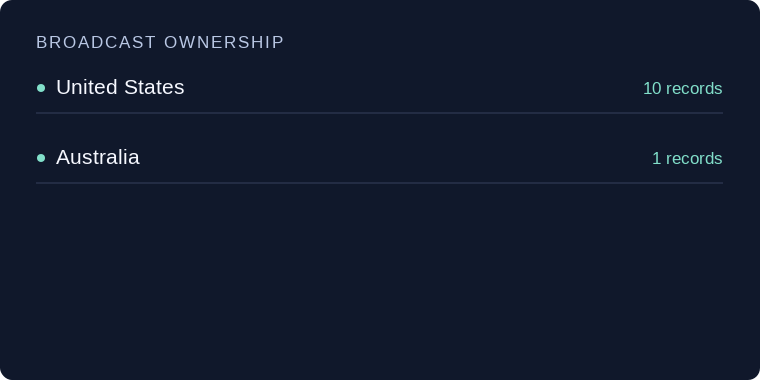
PBS, PBS Kids Eastern/Central and PBS Kids Mountain appear together when the records are grouped by the owner label PBS Member Public Television Stations. The published guide follows 11 individual station records, with 10 assigned to United States. That distinction matters if you remember the group name in a programme credit but need the station that actually listed the programme.
The date attached to PBS is 5 October 1970. The date recorded for PBS Kids Australia is 1 July 2021. They tell you about those stations’ launch records. Use the separate owner field for the association with PBS Member Public Television Stations, and the listed market to choose the edition you need.
The chronology opens with Az TV, dated 14 February 1956. At the other end is Alvin Channel TV on 3 December 2020. Reading between the two is a way to place an older service in its broadcast period, particularly when a present-day channel list starts with alphabetical order and hides launch dates.
Of the 9 dated entries in this group, 3 fall in the 2000s. That count follows the specific category and source market named in the article. For a reference to Az TV or Alvin Channel TV, start with its own row. A concentration of launches in one decade cannot establish the date of a particular programme.
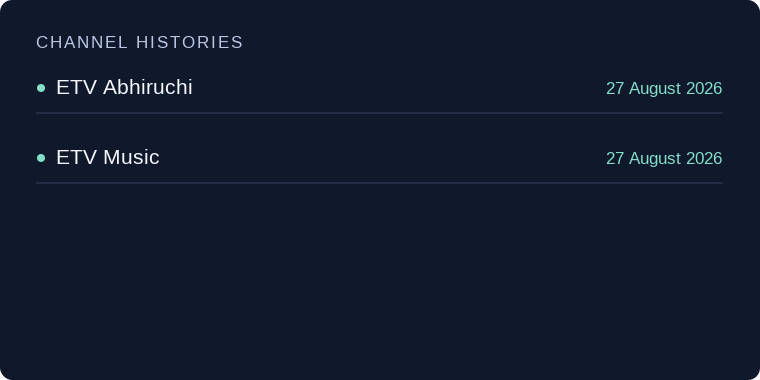
An old guide may still contain ETV Abhiruchi. Following its reference to the next station yields ETV Music in India. The names belong to separate catalogue identifiers, ETVAbhiruchi.in and ETVMusic.in. Preserve both if you are matching a recording made close to the handover.
The former entry records 27 August 2026 as its closing date. The next entry gives 27 August 2026 as its launch. Those two dates answer a narrower question than “when did the picture change on my TV?” They identify the change documented for ETV Abhiruchi and give you two names to try in a historical listing.