
The stations listed under RTL Group S.A.
The broadcast directory credits RTL Group S.A. as owner on 11 station records. RTL, RTL Zwei, RTL Crime show how that credit appears under different station names.
Where the names appear
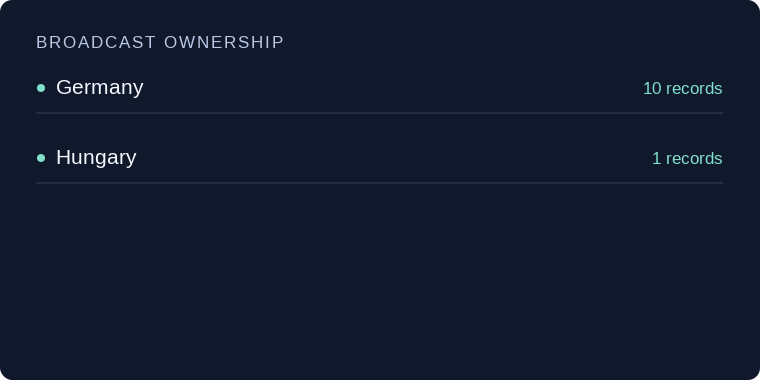
The largest source-market group in this set is Germany, with 10 of 11 records. There are 11 distinct display names. The most frequently recorded programme categories include series.
| Market | Station records |
|---|---|
| Germany | 10 |
| Hungary | 1 |
A dated cross-section
The earliest recorded launch in this set belongs to RTL on 2 January 1984. At the other end, RTLup is dated 4 June 2016. These dates belong to the individual stations. They do not establish when ownership or affiliation began.
Source edition dated 1 November 2026. Historical station records identify names and relationships. They do not describe a TREX account’s current channel lineup.
Which network names accompany the owner credit?
Searching for RTL Group S.A. as an owner produces 11 station records. Counting printed station names instead gives 11. No row in this group supplies a corresponding network field. The names RTL, RTL Zwei, and RTL Crime can still be used to look up individual station records. This difference in search fields matters when an old newspaper, programme credit or company announcement names a broadcaster differently from the guide on your screen.
Germany contributes 10 of the 11 rows. Other represented markets include Hungary (1). Look at the actual station and its source market before treating a similar corporate label as the same business abroad. The database is a list of submitted relationships. It supplies no legal chain of control or date of purchase for RTL Group S.A..
Reading the entries for RTL and RTL Gold
Put RTL beside RTL Gold. The RTL record here belongs to Germany. The comparison entry for RTL Gold belongs to Hungary. The owner field on both contains RTL Group S.A., so the owner name alone cannot separate them. If a guide abbreviates a name, copy the complete identifier for the result you want before comparing any programmes. Matching these identity fields gets you to the right record even when the player sorts the results differently.
To see where this article’s selection ends, compare RTLup with Animax in Germany. The latter sits outside the group of 11 station records examined above. Its launch is dated 5 June 2007. There are 697 other local records in the local catalogue beyond this article’s membership. Finding a station in the same country or category therefore answers a different question from establishing the particular relationship on this page.
What a listener or viewer can actually search
RTL Gold has no programme category in the station file. The neighbouring record for RTL has no category attached. A general-service schedule can put a bulletin, a match and a film on the same station in one evening. The category on a channel directory describes a broad service rather than any individual programme. If you are working from the RTL Group S.A. list, RTL Gold is the example to look up. Write down one programme title and the next item shown in the guide. Two consecutive titles can distinguish a local edition when a cropped logo cannot.
Typing RTL into a guide can lead to more than one entry. This edition carries the identifier RTL.de. The catalogue also uses the name for RTL.hr in Croatia. A player’s search screen can shorten both to identical text. Open the programme details and compare the market field before adding either result to favourites. Keeping both identifiers beside a screenshot makes the mix-up much easier to explain.
Dates and location on the underlying records
The launch field for RTL Gold is empty in the source edition. That is an unknown date, even when the website or logo looks familiar. Two dated points for comparison are RTL (1997) and Film+ (2004). A date from a neighbouring service cannot fill this gap. For an archive entry, cite the date on the actual recording or newspaper listing and leave the broadcaster’s launch year unassigned until a source ties it to RTLGold.hu.
Take a hypothetical listing for RTLup at 20:30 UTC on 15 December 2026. In Berlin that becomes 21:30 on 15 December. Move the very same UTC start to 15 June 2027 and Berlin reads 22:30 on 15 June. Carrying a December offset into a June guide would change the result. Use the time in the city where you watch when setting a reminder. Neither example is a claim about a programme carried by RTLup.