
The stations listed under National Media Group
The broadcast directory credits National Media Group as owner on 21 station records. Channel 5, REN TV, NTV Kenya show how that credit appears under different station names.
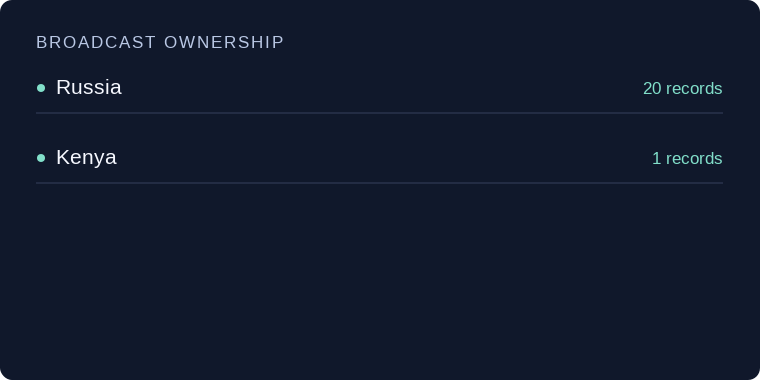
Where the names appear
The largest source-market group in this set is Russia, with 20 of 21 records. There are 21 distinct display names. The most frequently recorded programme categories include movies, general, documentary, series.
| Market | Station records |
|---|---|
| Russia | 20 |
| Kenya | 1 |
A dated cross-section
The earliest recorded launch in this set belongs to Channel 5 on 7 July 1938. At the other end, viju TV1000 romantica is dated 25 November 2024. These dates belong to the individual stations. They do not establish when ownership or affiliation began.
| Service | Source market | Launch recorded | Closure recorded | Network or category |
|---|---|---|---|---|
| Channel 5 | Russia | 7 July 1938 | — | general |
| REN TV | Russia | 19 July 1993 | — | general |
| NTV Kenya | Kenya | 10 December 1999 | — | general |
| viju+ Sport | Russia | 1 November 2006 | — | sports |
| REN TV International | Russia | 1 June 2016 | — | general |
| viju TV1000 novella | Russia | 27 November 2023 | — | movies |
| viju TV1000 romantica | Russia | 25 November 2024 | — | series |
What the stations carry
| Programme category | Named examples | In this set |
|---|---|---|
| Movies | viju TV1000 novella, viju TV1000, viju TV1000 action | 6 |
| General | Channel 5, REN TV, NTV Kenya | 5 |
| Documentary | viju Explore, viju History, viju Nature | 4 |
| News | 78, Izvestia | 2 |
| Series | viju TV1000 romantica, viju+ Serial | 2 |
| Comedy | viju+ Comedy | 1 |
Source edition dated 1 November 2026. Historical station records identify names and relationships. They do not describe a TREX account’s current channel lineup.
Which network names accompany the owner credit?
Searching for National Media Group as an owner produces 21 station records. Counting printed station names instead gives 21. The most frequent filled network field is Viasat, attached to 3 rows. You can see that credit on entries for viju TV1000, viju TV1000 action, and viju TV1000 russkoe. This difference in search fields matters when an old newspaper, programme credit or company announcement names a broadcaster differently from the guide on your screen.
Russia contributes 20 of the 21 rows. Other represented markets include Kenya (1). Look at the actual station and its source market before treating a similar corporate label as the same business abroad. The database is a list of submitted relationships. It supplies no legal chain of control or date of purchase for National Media Group.
Reading the entries for Channel 5 and viju TV1000 russkoe
Put Channel 5 beside viju TV1000 russkoe. Both entries give Russia as their market. The owner field on both contains National Media Group, so the owner name alone cannot separate them. If a guide abbreviates a name, copy the complete identifier for the result you want before comparing any programmes. Matching these identity fields gets you to the right record even when the player sorts the results differently.
To see where this article’s selection ends, compare viju Explore with Planeta HD in Russia. The latter sits outside the group of 21 station records examined above. Its launch is dated 22 April 2016. There are 28 other local records under the documentary category beyond this article’s membership. Finding a station in the same country or category therefore answers a different question from establishing the particular relationship on this page.
What a listener or viewer can actually search
viju TV1000 russkoe carries the movies classification in the station file. One point of comparison is Channel 5, filed under general. Film repeats can share the same title and poster even when the guide entries have different dates or language tracks. A channel number by itself also loses meaning when favourites are reordered. If you are working from the National Media Group list, viju TV1000 russkoe is the example to look up. Write down the film, the credited year if the guide supplies it, and the time the listing begins. Those three details make a much stronger match.
Typing Channel 5 into a guide can lead to more than one entry. This edition carries the identifier Channel5.ru. The catalogue also uses the name for Channel5.kg in Kyrgyzstan. A player’s search screen can shorten both to identical text. Open the programme details and compare the market field before adding either result to favourites. Keeping both identifiers beside a screenshot makes the mix-up much easier to explain.
Dates and location on the underlying records
The launch field for viju TV1000 russkoe is empty in the source edition. That is an unknown date, even when the website or logo looks familiar. Two dated points for comparison are viju TV1000 novella (2023) and viju TV1000 romantica (2024). A date from a neighbouring service cannot fill this gap. For an archive entry, cite the date on the actual recording or newspaper listing and leave the broadcaster’s launch year unassigned until a source ties it to vijuTV1000russkoe.ru.
Take a hypothetical listing for viju Explore at 20:30 UTC on 15 December 2026. In Kaliningrad that becomes 22:30 on 15 December. The June example gives 22:30 on 15 June for a 20:30 UTC announcement on 15 June 2027. Both examples retain the printed local date. Use the time in the city where you watch when setting a reminder. Neither example is a claim about a programme carried by viju Explore.