
SBS across the broadcast dial
The broadcast directory credits SBS as network on 10 station records. HLDE-DTV, HLDF-DTV, HLDG-DTV show how that credit appears under different station names.
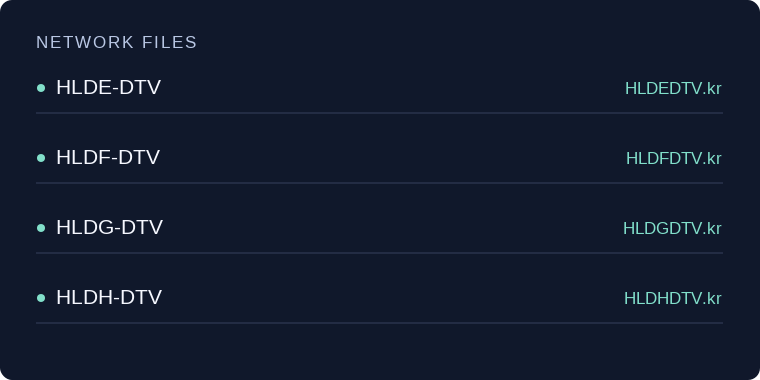
Where the names appear
The largest source-market group in this set is South Korea, with 10 of 10 records. There are 10 distinct display names. The most frequently recorded programme categories include general, sports.
| Market | Station records |
|---|---|
| South Korea | 10 |
A dated cross-section
The earliest recorded launch in this set belongs to HLDE-DTV on 14 May 1995. At the other end, SBS Sports is dated 1 January 2014. These dates belong to the individual stations. They do not establish when ownership or affiliation began.
| Service | Source market | Launch recorded | Closure recorded | Network or category |
|---|---|---|---|---|
| HLDE-DTV | South Korea | 14 May 1995 | — | SBS |
| HLDF-DTV | South Korea | 14 May 1995 | — | SBS |
| HLDG-DTV | South Korea | 14 May 1995 | — | SBS |
| HLDH-DTV | South Korea | 14 May 1995 | — | SBS |
| HLDP-DTV | South Korea | 1 September 1997 | — | SBS |
| HLDQ-DTV | South Korea | 27 September 1997 | — | SBS |
| HLDR-DTV | South Korea | 18 October 1997 | — | SBS |
| HLCG-DTV | South Korea | 15 December 2001 | — | SBS |
| HLKJ-DTV | South Korea | 31 May 2002 | — | SBS |
| SBS Sports | South Korea | 1 January 2014 | — | SBS |
What the stations carry
| Programme category | Named examples | In this set |
|---|---|---|
| General | HLDE-DTV, HLDF-DTV, HLDG-DTV | 9 |
| Sports | SBS Sports | 1 |
Source edition dated 1 November 2026. Historical station records identify names and relationships. They do not describe a TREX account’s current channel lineup.
Who operates the listed stations?
Searching for SBS as a network produces 10 station records. Counting printed station names instead gives 10. The most frequent filled owner field is Taegu Broadcasting Corporation, attached to 1 row. You can see that credit on entries for HLDE-DTV. This difference in search fields matters when an old newspaper, programme credit or company announcement names a broadcaster differently from the guide on your screen.
South Korea contributes 10 of the 10 rows. Every record in the set points back to South Korea. Look at the actual station and its source market before treating a similar corporate label as the same business abroad. The database is a list of submitted relationships. It supplies no legal chain of control or date of purchase for SBS.
Reading the entries for HLDE-DTV and SBS Sports
Put HLDE-DTV beside SBS Sports. Both entries give South Korea as their market. The two rows both name SBS as network. That narrows a family of services without identifying a particular feed. If a guide abbreviates a name, copy the complete identifier for the result you want before comparing any programmes. Matching these identity fields gets you to the right record even when the player sorts the results differently.
To see where this article’s selection ends, compare HLDQ-DTV with HLAT-DTV in South Korea. The latter sits outside the group of 10 station records examined above. Its launch is dated 21 November 1987. There are 62 other local records under the general category beyond this article’s membership. Finding a station in the same country or category therefore answers a different question from establishing the particular relationship on this page.
A closer look at one local station
Start with HLDQ-DTV if you can type the complete label. The search terms JTV, 전주방송, and 全州放送 also appear on the South Korea record. They are alternate names attached to one station identity, HLDQDTV.kr. A remote that drops accents, punctuation or part of a long name may display just one spelling. Finding two of those names in the same guide is a reason to compare their programmes before keeping both as favourites.
HLDQ-DTV carries the general classification in the station file. One point of comparison is SBS Sports, filed under sports. A general-service schedule can put a bulletin, a match and a film on the same station in one evening. The category on a channel directory describes a broad service rather than any individual programme. If you are working from the SBS list, HLDQ-DTV is the example to look up. Write down one programme title and the next item shown in the guide. Two consecutive titles can distinguish a local edition when a cropped logo cannot.
Following the station beyond the network label
The date attached to HLDE-DTV is 14 May 1995. YTN is the closest earlier launch in this comparison, dated 1 March 1995. The closest later date belongs to CTS TV on 1 December 1995. Other rows from the same calendar year include GS Shop, BTN TV, and Daekyo Kids TV. These are markers on a timeline drawn from the selected records. A row that sits immediately before HLDE-DTV in date order does not automatically name the channel it replaced.
The catalogue gives SBS Sports the owner credit Seoul Broadcasting System. This is the only record in this snapshot carrying that exact spelling. Keep the name beside the station identifier when comparing an old guide with a company directory. Different abbreviations or a later corporate name can produce other results. The record here does not date a purchase or say which company now sells a subscription in South Korea.