
Which JTV is in your programme guide?
The directory has 4 separate records carrying the name JTV across 4 source markets, including South Korea, Indonesia, Mozambique, United States. A search by the display name alone can return the wrong broadcaster.
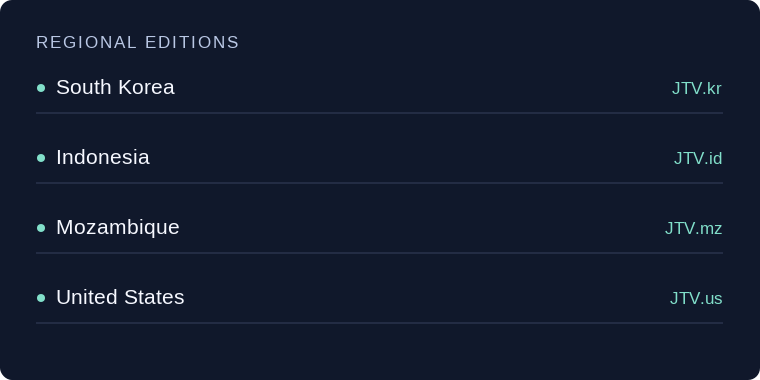
The editions side by side
| Station | Market | Name also recorded | Catalogue ID |
|---|---|---|---|
| JTV | South Korea | 전주방송 | JTV.kr |
| JTV | Indonesia | — | JTV.id |
| JTV | Mozambique | — | JTV.mz |
| JTV | United States | Jackson TV | JTV.us |
Which entry matches your screen?
In South Korea, the entry also uses 전주방송. The dated entries include JTV (27 September 1997, South Korea), JTV (8 November 2001, Indonesia). Use the source market and the station ID to tell these JTV entries apart before checking the programme at your local time.
Source edition dated 1 November 2026. Historical station records identify names and relationships. They do not describe a TREX account’s current channel lineup.
How to separate the results on one screen
Start with the country in which the station is listed. The spelling JTV occurs across 4 markets in this comparison. In South Korea use JTV.kr. In Indonesia use JTV.id. Look for 전주방송 if the first spelling in the South Korea guide fails. For Indonesia, the full identifier JTV.id is a better second search than guessing a translation. The country attached to a station describes where the record is filed, not which subscriptions include a stream in somebody else’s household.
Does a second name settle it? Of the 4 station rows grouped here, 2 include at least one alternate spelling. Comparing those spellings without regard to letter case gives 2 distinct aliases. For 2 entries, the display name is the only spelling supplied. With two search results on screen, keep the identifier containing the source market and the programme you expected. A logo shared across language editions may supply less information than either of those details.
Reading the entries for JTV and JTV
Put JTV beside JTV. The JTV record here belongs to South Korea. The comparison entry for JTV belongs to United States. The most dependable discriminator in these rows is the pair of station IDs, JTV.kr and JTV.us. If a guide abbreviates a name, copy the complete identifier for the result you want before comparing any programmes. Matching these identity fields gets you to the right record even when the player sorts the results differently.
To see where this article’s selection ends, compare JTV with Kingdom TV in Mozambique. The latter sits outside the group of 4 station records examined above. Its launch is dated 1 January 2020. There are 9 other local records under the religious category beyond this article’s membership. Finding a station in the same country or category therefore answers a different question from establishing the particular relationship on this page.
The programmes behind the display name
JTV carries the general classification in the station file. The same search can also suggest JTV, which shares a category with JTV. A general-service schedule can put a bulletin, a match and a film on the same station in one evening. The category on a channel directory describes a broad service rather than any individual programme. For JTV, start with the broadcast itself. Write down one programme title and the next item shown in the guide. Two consecutive titles can distinguish a local edition when a cropped logo cannot.
Typing JTV into a guide can lead to more than one entry. This edition carries the identifier JTV.us. The catalogue also uses the name for JTV.id in Indonesia. A player’s search screen can shorten both to identical text. Open the programme details and compare the market field before adding either result to favourites. Keeping both identifiers beside a screenshot makes the mix-up much easier to explain.
An example across the two guide clocks
Suppose two guide entries are due at 20:30 UTC on 15 December 2026. For JTV, reading that instant on the clock in Seoul gives 05:30 on 16 December. For JTV, the clock in New York gives 15:30 on 15 December. This is a worked conversion, not a published start time for either broadcaster. Look for the city or time-zone label on a saved listing before assigning it to one of those dates.
The website field on the JTV record points to jtv.tv. No other station in the packaged snapshot uses that exact recorded web domain. A domain is a useful check on the spelling of a brand. A corporate home page can still lead to several programme schedules. When looking for JTV in United States, carry the station title into the site search and open the relevant regional guide before comparing programme times.
What other records can establish about JTV
Consider what survives if you have an old schedule with a station name and a year but no logo. Across the records behind this JTV article, 2 of the 4 rows have a launch date, 2 have an alternate name, and 1 supply both. JTV can be found under the date 27 September 1997 or via the alternate name 전주방송. Two points of agreement let you investigate an identity more closely. Missing data in one field is an invitation to consult the original schedule.
There is no direct replacement link between any two of the 4 rows in this particular group. The shared subject of JTV is not evidence that JTV handed its schedule to JTV. If a newspaper or recording supplies another spelling, retain the original words and their date beside your modern lookup. That keeps the contemporary evidence visible if a catalogue entry changes later.
The November edition records 3 station website fields in the records behind this JTV article. A site attached to a station can help find a primary programme listing. Its presence does not date a schedule change, and an owner group may use one address for several different channels. When quoting JTV, retain the precise programme page or printed listing you actually checked.