
Which E! is in your programme guide?
The directory has 11 separate records carrying the name E! across 11 source markets, including United States, Canada, Australia, New Zealand. A search by the display name alone can return the wrong broadcaster.
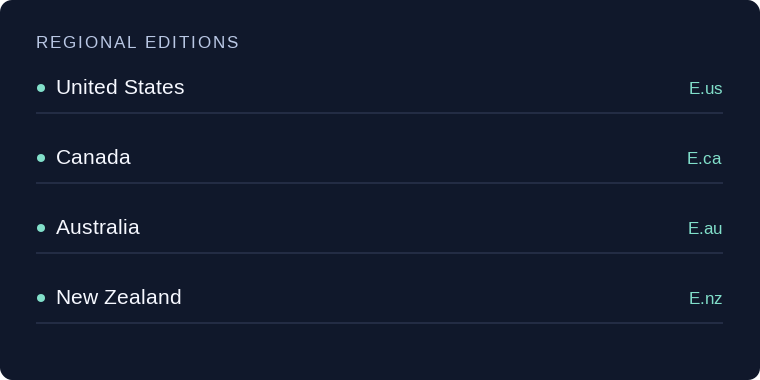
The editions side by side
| Station | Market | Name also recorded | Catalogue ID |
|---|---|---|---|
| E! | United States | Entertainment, Movietime | E.us |
| E! | Canada | Entertainment, Star! | E.ca |
| E! | Australia | Entertainment | E.au |
| E! | New Zealand | Entertainment | E.nz |
| E! | France | Entertainment | E.fr |
| E! | Israel | Entertainment | E.il |
| E! | Italy | Entertainment | E.it |
| E! | Poland | Entertainment | E.pl |
| E! | Romania | — | E.ro |
| E! | United Kingdom | E! Entertainment | E.uk |
| E! | Russia | Entertainment | E.ru |
Which entry matches your screen?
In United States, the entry also uses Entertainment, Movietime. The dated entries include E! (31 July 1987, United States), E! (10 September 1999, Canada), E! (1 April 2002, Australia). Use the source market and the station ID to tell these E! entries apart before checking the programme at your local time.
Source edition dated 1 November 2026. Historical station records identify names and relationships. They do not describe a TREX account’s current channel lineup.
How to separate the results on one screen
Start with the country in which the station is listed. The spelling E! occurs across 11 markets in this comparison. In United States use E.us. In Canada use E.ca. Look for Entertainment and Movietime if the first spelling in the United States guide fails. For Canada, the directory also supplies Entertainment and Star!. The country attached to a station describes where the record is filed, not which subscriptions include a stream in somebody else’s household.
Does a second name settle it? Of the 11 station rows grouped here, 10 include at least one alternate spelling. Comparing those spellings without regard to letter case gives 4 distinct aliases. For 1 entry, the display name is the only spelling supplied. With two search results on screen, keep the identifier containing the source market and the programme you expected. A logo shared across language editions may supply less information than either of those details.
Reading the entries for E! and E!
Put E! beside E!. The E! record here belongs to United States. The comparison entry for E! belongs to Russia. Their recorded launch dates also differ, 31 July 1987 for E! and 25 April 2014 for E!. If a guide abbreviates a name, copy the complete identifier for the result you want before comparing any programmes. Matching these identity fields gets you to the right record even when the player sorts the results differently.
To see where this article’s selection ends, compare E! with HOT Entertainment in Israel. The latter sits outside the group of 11 station records examined above. Its row gives the identifier HOTEntertainment.il without a launch date. There are 4 other local records under the entertainment category beyond this article’s membership. Finding a station in the same country or category therefore answers a different question from establishing the particular relationship on this page.
The programmes behind the display name
E! carries the entertainment classification in the station file. The same search can also suggest E!, which shares a category with E!. A variety show can be listed under the guest, the episode title or the name of a larger strand. A repeat may carry the same thumbnail as the original broadcast. For E!, start with the broadcast itself. Open the full listing and retain the episode description or its adjoining programme. It gives you a second reference when two entries share the headline.
Typing E! into a guide can lead to more than one entry. This edition carries the identifier E.ru. The catalogue also uses the name for E.au in Australia. A player’s search screen can shorten both to identical text. Open the programme details and compare the market field before adding either result to favourites. Keeping both identifiers beside a screenshot makes the mix-up much easier to explain.
An example across the two guide clocks
Suppose two guide entries are due at 20:30 UTC on 15 December 2026. For E!, reading that instant on the clock in New York gives 15:30 on 15 December. For E!, the clock in Kaliningrad gives 22:30 on 15 December. This is a worked conversion, not a published start time for either broadcaster. Look for the city or time-zone label on a saved listing before assigning it to one of those dates.
E! appears among 906 station records filed under Russia in this edition. The row supplies neither a network nor an owner credit. That gap matters if another guide uses the same logo for several services. Keep the station identifier E.ru with the local programme name and leave corporate attribution open until a primary source supplies it.