
From Syfy to SciFi
The broadcast directory links Syfy in France to SciFi as its successor. The former service has a recorded closing date of 17 March 2026.
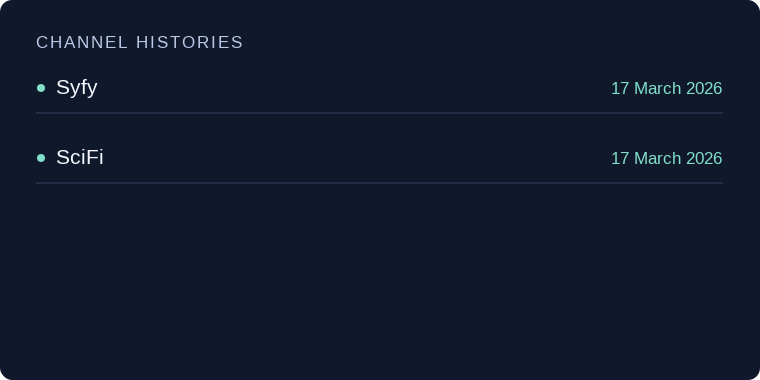
The recorded handover
Syfy closed on 17 March 2026. The successor entry is SciFi, with a launch dated 17 March 2026. The two dates coincide.
Names to look for in an older guide
How long did the old names run?
| Name in the directory | Recorded period | Elapsed days |
|---|---|---|
| Syfy | 2 December 2005 to 17 March 2026 | 7,410 |
Source edition dated 1 November 2026. Historical station records identify names and relationships. They do not describe a TREX account’s current channel lineup.
Following the successor field
The catalogue traces 1 direct replacement link across 2 station records. Start with the entry filed as Syfy. Its own successor field points to SciFi.fr, the identifier for SciFi. Reading in the opposite direction from a familiar newer label can turn up more than one earlier station, and each has its own dates.
The earliest side of the recorded chain contains Syfy. At the other end the local set leads to SciFi. For the Syfy to SciFi step, 17 March 2026 appears as the closure date in the earlier row and the launch date in the later one. None of these date fields records the exact hour of a final transmission, so a saved programme from the changeover day needs its original local listing.
Reading the entries for Syfy and SciFi
Put Syfy beside SciFi. Both entries give France as their market. The respective owner fields give NBCUniversal and NBC UNIVERSAL GLOBAL NETWORKS ESPANA S.L.U. and Comcast Corporation. If a guide abbreviates a name, copy the complete identifier for the result you want before comparing any programmes. Matching these identity fields gets you to the right record even when the player sorts the results differently.
To see where this article’s selection ends, compare SciFi with FX 1 in France. The latter sits outside the group of 2 station records examined above. Its launch is dated 10 December 2007. There are 42 other local records under the entertainment category beyond this article’s membership. Finding a station in the same country or category therefore answers a different question from establishing the particular relationship on this page.
Identifying a recording of Syfy
Typing Syfy into a guide can lead to more than one entry. This edition carries the identifier Syfy.fr. The catalogue also uses the name for SYFY.de in Germany. A player’s search screen can shorten both to identical text. Open the programme details and compare the market field before adding either result to favourites. Keeping both identifiers beside a screenshot makes the mix-up much easier to explain.
For an archive enquiry about Syfy, start with the date on the recording, the station label in the corner and a programme title if it survives. Attach Syfy.fr as the catalogue reference, then ask whether the dated recording belongs to this France edition. If a newer station is offered in reply, keep the old and new identifiers separate in your notes so the original label remains searchable.
Another way to date the record
The date attached to SciFi is 17 March 2026. zenith supplies the closest earlier date in the comparison, 1 February 2026. There is no later dated launch within this set. Other rows from the same calendar year include zenith. These are markers on a timeline drawn from the selected records. A row that sits immediately before SciFi in date order does not automatically name the channel it replaced.
Take a hypothetical listing for SciFi at 20:30 UTC on 15 December 2026. In Paris that becomes 21:30 on 15 December. Move the very same UTC start to 15 June 2027 and Paris reads 22:30 on 15 June. Carrying a December offset into a June guide would change the result. Use the time in the city where you watch when setting a reminder. Neither example is a claim about a programme carried by SciFi.
What other records can establish about Syfy
Consider what survives if you have an old schedule with a station name and a year but no logo. Across the records behind this Syfy article, 2 of the 2 rows have a launch date, 1 have an alternate name, and 1 supply both. SciFi can be found under the date 17 March 2026 or via the alternate name SyFy and SF. Two points of agreement let you investigate an identity more closely. Missing data in one field is an invitation to consult the original schedule.
A separate relationship is available inside this selection. The successor field links Syfy directly to SciFi. That is stronger evidence of a station change than two neighbouring launch dates. If a newspaper or recording supplies another spelling, retain the original words and their date beside your modern lookup. That keeps the contemporary evidence visible if a catalogue entry changes later.
The November edition records 2 station website fields in the records behind this Syfy article. A site attached to a station can help find a primary programme listing. Its presence does not date a schedule change, and an owner group may use one address for several different channels. When quoting Syfy, retain the precise programme page or printed listing you actually checked.