
From Circle to Circle Country
The broadcast directory links Circle in United States to Circle Country as its successor. The former service has a recorded closing date of 31 December 2023.
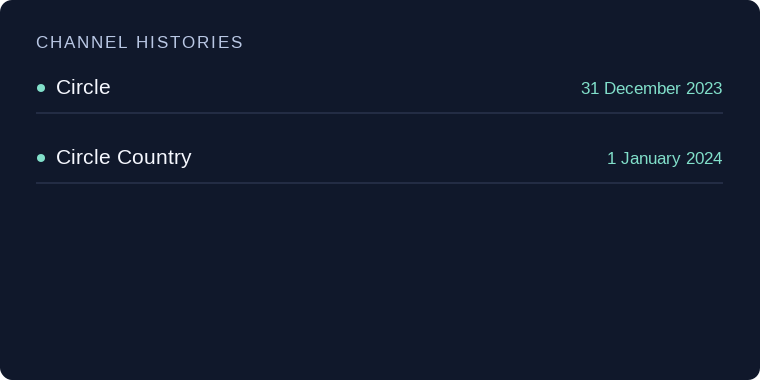
The recorded handover
Circle closed on 31 December 2023. The successor entry is Circle Country, with a launch dated 1 January 2024. The recorded dates are 1 days apart.
Names to look for in an older guide
| Station | Market | Name also recorded | Catalogue ID |
|---|---|---|---|
| Circle | United States | — | Circle.us |
| Circle Country | United States | — | CircleCountry.us |
How long did the old names run?
| Name in the directory | Recorded period | Elapsed days |
|---|---|---|
| Circle | 1 January 2020 to 31 December 2023 | 1,460 |
Source edition dated 1 November 2026. Historical station records identify names and relationships. They do not describe a TREX account’s current channel lineup.
Following the successor field
The catalogue traces 1 direct replacement link across 2 station records. Start with the entry filed as Circle. Its own successor field points to CircleCountry.us, the identifier for Circle Country. Reading in the opposite direction from a familiar newer label can turn up more than one earlier station, and each has its own dates.
The earliest side of the recorded chain contains Circle. At the other end the local set leads to Circle Country. The Circle closing date precedes the opening recorded for Circle Country by 1 day. The intervening interval is visible in the entries. None of these date fields records the exact hour of a final transmission, so a saved programme from the changeover day needs its original local listing.
Reading the entries for Circle and Circle Country
Put Circle beside Circle Country. Both entries give United States as their market. The owner field on both contains PowerNation, so the owner name alone cannot separate them. If a guide abbreviates a name, copy the complete identifier for the result you want before comparing any programmes. Matching these identity fields gets you to the right record even when the player sorts the results differently.
To see where this article’s selection ends, compare Circle Country with Antenna TV in United States. The latter sits outside the group of 2 station records examined above. Its launch is dated 30 August 2010. There are 341 other local records under the entertainment category beyond this article’s membership. Finding a station in the same country or category therefore answers a different question from establishing the particular relationship on this page.
Identifying a recording of Circle
The United States entry is indexed as Circle, with no alternate display name supplied in this snapshot. A nearby search may return Circle Country as well. Use the complete printed title of Circle and its identifier, Circle.us, to label an old recording or guide note. A number supplied by a television’s favourites list has meaning on that television, but a different player can place the same station elsewhere.
For an archive enquiry about Circle, start with the date on the recording, the station label in the corner and a programme title if it survives. Attach Circle.us as the catalogue reference, then ask whether the dated recording belongs to this United States edition. If a newer station is offered in reply, keep the old and new identifiers separate in your notes so the original label remains searchable.
Another way to date the record
The date attached to Circle Country is 1 January 2024. Dungeons & Dragons Adventures is the closest earlier launch in this comparison, dated 15 November 2023. The closest later date belongs to TNT Sports on 18 January 2024. Other rows from the same calendar year include 365BLK, Outlaw, and TNT Sports. These are markers on a timeline drawn from the selected records. A row that sits immediately before Circle Country in date order does not automatically name the channel it replaced.
Take a hypothetical listing for Circle Country at 20:30 UTC on 15 December 2026. In New York that becomes 15:30 on 15 December. Move the very same UTC start to 15 June 2027 and New York reads 16:30 on 15 June. Carrying a December offset into a June guide would change the result. Use the time in the city where you watch when setting a reminder. Neither example is a claim about a programme carried by Circle Country.
What other records can establish about Circle
Consider what survives if you have an old schedule with a station name and a year but no logo. Across the records behind this Circle article, 2 of the 2 rows have a launch date, 0 have an alternate name, and 0 supply both. For a row such as Circle.us, keep the displayed station name and country together if one of those fields is unavailable. Two points of agreement let you investigate an identity more closely. Missing data in one field is an invitation to consult the original schedule.
A separate relationship is available inside this selection. The successor field links Circle directly to Circle Country. That is stronger evidence of a station change than two neighbouring launch dates. If a newspaper or recording supplies another spelling, retain the original words and their date beside your modern lookup. That keeps the contemporary evidence visible if a catalogue entry changes later.
The November edition records 2 station website fields in the records behind this Circle article. A site attached to a station can help find a primary programme listing. Its presence does not date a schedule change, and an owner group may use one address for several different channels. When quoting Circle, retain the precise programme page or printed listing you actually checked.