
Japan on air: a general television timeline
From NHK General TV in 1953 to RecordTV Japan in 2016, the directory supplies launch dates for 28 general station records in Japan.
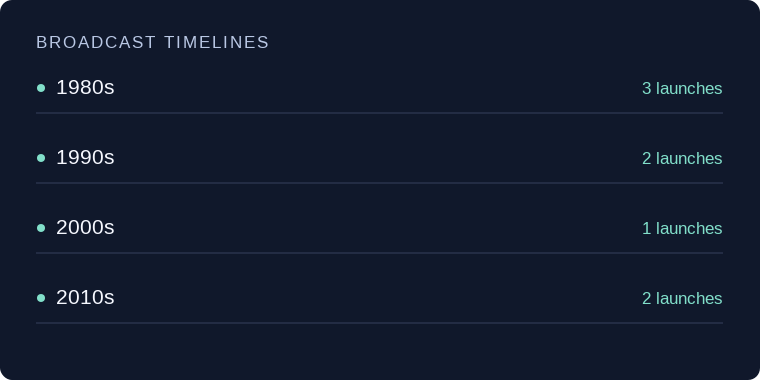
The launch years
The 1950s account for 11 launches in this dated group. The first full date is 1 February 1953 for NHK General TV. The latest is 24 November 2016 for RecordTV Japan. Stations without a recorded date are outside this comparison.
| Decade | Recorded launches |
|---|---|
| 1950s | 11 |
| 1960s | 5 |
| 1970s | 4 |
| 1980s | 3 |
| 1990s | 2 |
| 2000s | 1 |
| 2010s | 2 |
A chronology of the stations
| Service | Source market | Launch recorded | Closure recorded | Network or category |
|---|---|---|---|---|
| NHK General TV | Japan | 1 February 1953 | — | general |
| Nippon TV | Japan | 28 August 1953 | — | NNN/NNS |
| TBS TV | Japan | 1 April 1955 | — | JNN/TBS Network |
| ABC TV | Japan | 1 December 1956 | — | ANN |
| Yomiuri TV | Japan | 28 August 1958 | — | NNN/NNS |
| Kansai TV | Japan | 22 November 1958 | — | FNN/FNS |
| BSN TV | Japan | 24 December 1958 | — | general |
| TV Asahi | Japan | 1 February 1959 | — | ANN/TV Asahi Network |
| Fuji TV | Japan | 1 March 1959 | — | FNN/FNS |
| MBS TV | Japan | 1 March 1959 | — | JNN/TBS Network |
| IBC TV | Japan | 1 September 1959 | — | JNN/TBS Network |
| TV Kanagawa | Japan | 1 April 1972 | — | JAITS |
| TSS | Japan | 1 October 1975 | — | Fuji Television Network |
| TV Saitama | Japan | 1 April 1979 | — | JAITS |
| TV Osaka | Japan | 23 January 1981 | — | TVO |
| NHK BS | Japan | 12 May 1984 | — | general |
| TV-U Yamagata | Japan | 1 October 1989 | — | Japan News Network |
| Tulip TV | Japan | 1 October 1990 | — | JNN/TBS Network |
| Tokyo MX | Japan | 1 November 1995 | — | JAITS |
| KBS World Japan | Japan | 1 April 2006 | — | general |
| ABEMA Gold | Japan | 11 April 2016 | — | general |
| RecordTV Japan | Japan | 24 November 2016 | — | general |
Source edition dated 1 November 2026. Historical station records identify names and relationships. They do not describe a TREX account’s current channel lineup.
What the launch years reveal
This general chronology covers 28 dated station records for Japan, spread over 19 distinct calendar years. The highest annual count is 4. 1959 has that count, with TV Asahi, Fuji TV, and MBS TV among its dated entries. Counted here are station records that have a launch date and this first programme tag. The figure describes the source selection rather than every launch in the country.
The longest interval between successive distinct launch dates in this selection runs from 1 November 1995 to 1 April 2006, or 3,804 days. Tokyo MX and KBS World Japan identify the two ends. A blank stretch on this chart tells us about the available dates. It cannot establish that broadcasting stopped in Japan or that one of those two stations replaced the other.
Reading the entries for NHK General TV and RecordTV Japan
Put NHK General TV beside RecordTV Japan. Both entries give Japan as their market. Their recorded launch dates also differ, 1 February 1953 for NHK General TV and 24 November 2016 for RecordTV Japan. If a guide abbreviates a name, copy the complete identifier for the result you want before comparing any programmes. Matching these identity fields gets you to the right record even when the player sorts the results differently.
To see where this article’s selection ends, compare Sun TV with BS Asahi in Japan. The latter sits outside the group of 28 station records examined above. Its row gives the identifier BSAsahi.jp without a launch date. There are 8 other local records under the general category beyond this article’s membership. Finding a station in the same country or category therefore answers a different question from establishing the particular relationship on this page.
Locating NHK General TV in older schedules
Start with NHK General TV if you can type the complete label. The search terms NHK G and NHK総合テレビジョン also appear on the Japan record. They are alternate names attached to one station identity, NHKGeneralTV.jp. A remote that drops accents, punctuation or part of a long name may display just one spelling. Finding two of those names in the same guide is a reason to compare their programmes before keeping both as favourites.
RecordTV Japan carries the general classification in the station file. The same search can also suggest Sun TV, which shares a category with RecordTV Japan. A general-service schedule can put a bulletin, a match and a film on the same station in one evening. The category on a channel directory describes a broad service rather than any individual programme. For RecordTV Japan, start with the broadcast itself. Write down one programme title and the next item shown in the guide. Two consecutive titles can distinguish a local edition when a cropped logo cannot.
A station in its wider national timeline
The date attached to Sun TV is 1 May 1969. KBS Kyoto is the closest earlier launch in this comparison, dated 1 April 1969. The closest later date belongs to Aomori TV on 1 December 1969. Other rows from the same calendar year include Chukyo TV News, KBS Kyoto, and Aomori TV. These are markers on a timeline drawn from the selected records. A row that sits immediately before Sun TV in date order does not automatically name the channel it replaced.
The website field on the RecordTV Japan record points to recordjp.com. No other station in the packaged snapshot uses that exact recorded web domain. A domain is a useful check on the spelling of a brand. A corporate home page can still lead to several programme schedules. When looking for RecordTV Japan in Japan, carry the station title into the site search and open the relevant regional guide before comparing programme times.
What other records can establish about Japan
Consider what survives if you have an old schedule with a station name and a year but no logo. Across the records behind this Japan article, 28 of the 28 rows have a launch date, 24 have an alternate name, and 24 supply both. ABC TV can be found under the date 1 December 1956 or via the alternate name 朝日放送テレビ and ABCテレビ. Two points of agreement let you investigate an identity more closely. Missing data in one field is an invitation to consult the original schedule.
There is no direct replacement link between any two of the 28 rows in this particular group. The shared subject of Japan is not evidence that NHK General TV handed its schedule to RecordTV Japan. If a newspaper or recording supplies another spelling, retain the original words and their date beside your modern lookup. That keeps the contemporary evidence visible if a catalogue entry changes later.
The November edition records 28 station website fields in the records behind this Japan article. A site attached to a station can help find a primary programme listing. Its presence does not date a schedule change, and an owner group may use one address for several different channels. When quoting NHK General TV, retain the precise programme page or printed listing you actually checked.